4 to 5 hrs
London
London Full Day Private Tour - 'Skip-the-line' Tickets to Westminster Abbey
✓ Free cancellation Kids friendly
4.7(24 reviews)
From €276/ person
Book Now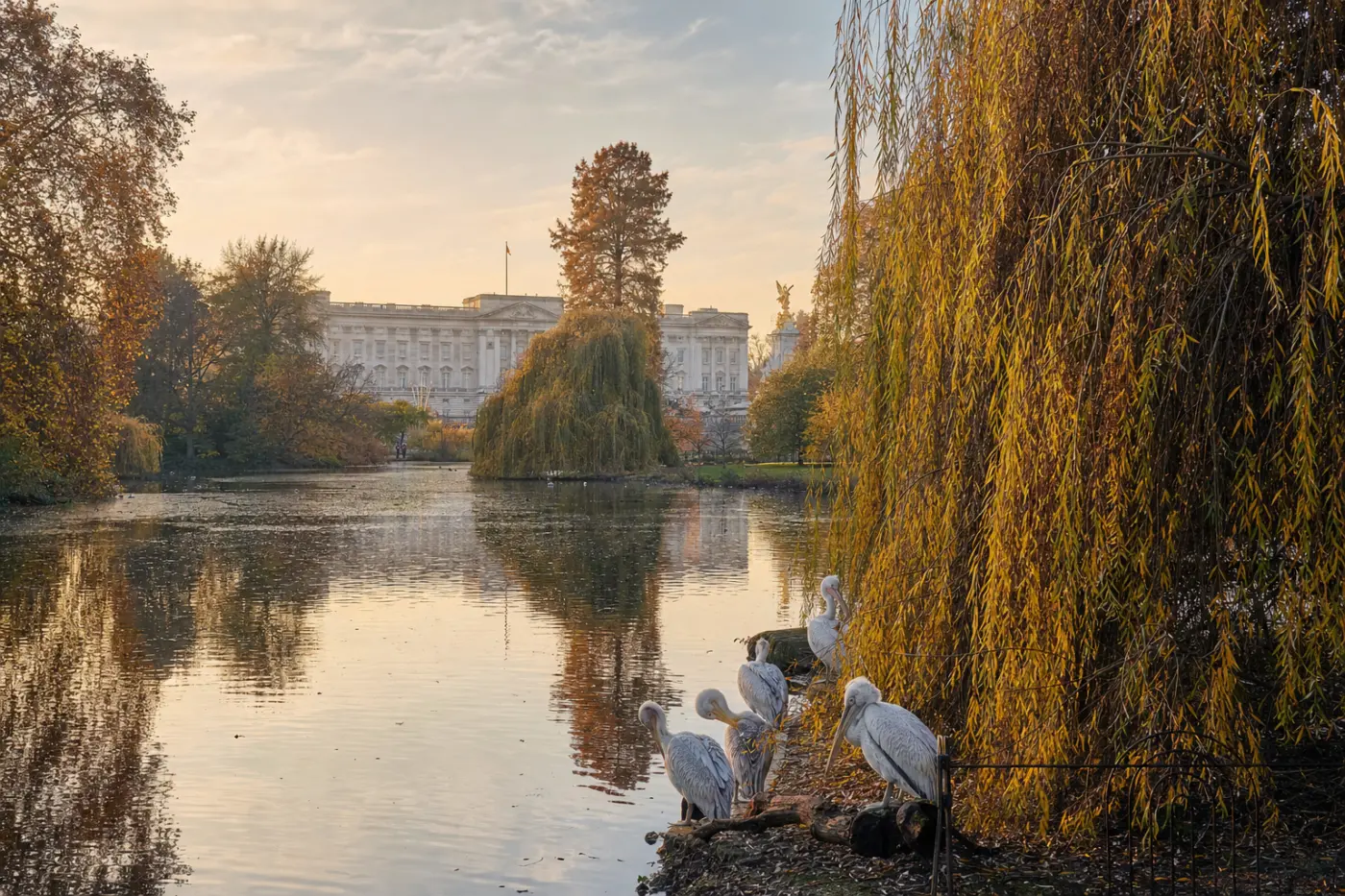
Tourist attraction
St. James's Park is the oldest of London's eight Royal Parks, covering 23 hectares at the very heart of Westminster, flanked by Buckingham Palace to the west, the Tudor facade of St. James's Palace to the north, and the government buildings of Whitehall to the east. Its origins trace to 1532, when Henry VIII purchased a tract of marshland bordering his newly seized Whitehall residence — itself taken from Cardinal Thomas Wolsey — intending to use it as a deer park. On its northern edge he constructed a hunting lodge that would eventually grow into St. James's Palace. The land took its name from a 13th-century hospital for female lepers dedicated to St. James the Less, which had occupied the site before the Tudor appropriation.
The marsh was drained and formally landscaped under James I after 1603, who stocked the grounds with an extraordinary royal menagerie: exotic birds, an elephant, crocodiles, and even a camel roamed what is now a tranquil public green. Charles II, returning from exile in France in 1660, remodelled the park along the fashionable French formal garden style and opened it to the public — making it one of the first royal spaces in England freely accessible to Londoners. It was Charles II who also received a gift of pelicans from the Russian Ambassador in 1664, beginning a tradition that continues unbroken to this day: a resident colony of pelicans still inhabits the park and is fed daily at 2:30 p.m. near Duck Island. The landscape was fundamentally reshaped once more in 1827 by John Nash, who replaced the formal French canal with a sinuous naturalistic lake and planted informal shrubberies in the English Romantic style. Nash's layout remains essentially intact, making the park a rare surviving example of Regency landscape design in an urban setting.
Visitors walking the central path across the Blue Bridge are rewarded with one of the most celebrated views in London: to the east, the ornate rooftops and spires of Whitehall and Horse Guards; to the west, the full facade of Buckingham Palace framed by weeping willows and open water. The 4.5-hectare St. James's Park Lake hosts over 15 species of waterfowl year-round, including great crested grebes, tufted ducks, and the famous pelicans. The park also sits directly on the route of the Changing of the Guard ceremony, and the adjacent Guards Memorial and the Household Cavalry parade add a pageant dimension unavailable anywhere else in the Royal Parks.
The park is open daily from 5:00 a.m. to midnight and is free to enter. The nearest Underground stations are St. James's Park (District and Circle lines) and Westminster (Jubilee, District, and Circle lines). The park's café, Inn the Park — housed in a low-slung, grass-roofed building designed by Michael Hopkins in 2004 — offers a terrace directly overlooking the lake and is worth a stop. Mornings on weekdays are noticeably quieter than weekends; arriving before 9:00 a.m. in spring or autumn means near-solitude among the willows and an excellent chance of watching the pelicans before the crowds gather.
Private tours with a local guide, at your own pace.
London
London

London
London
London
London
London

London

London
We use a single cookie, to remember this choice. We do not use analytics or advertising cookies. Read our cookie policy.