3 hrs
Rome
Rome: Private Walking Tour of Highlights & Secret Spots
✓ Free cancellation Kids friendly
5.0(27 reviews)
From €191/ person
Book Now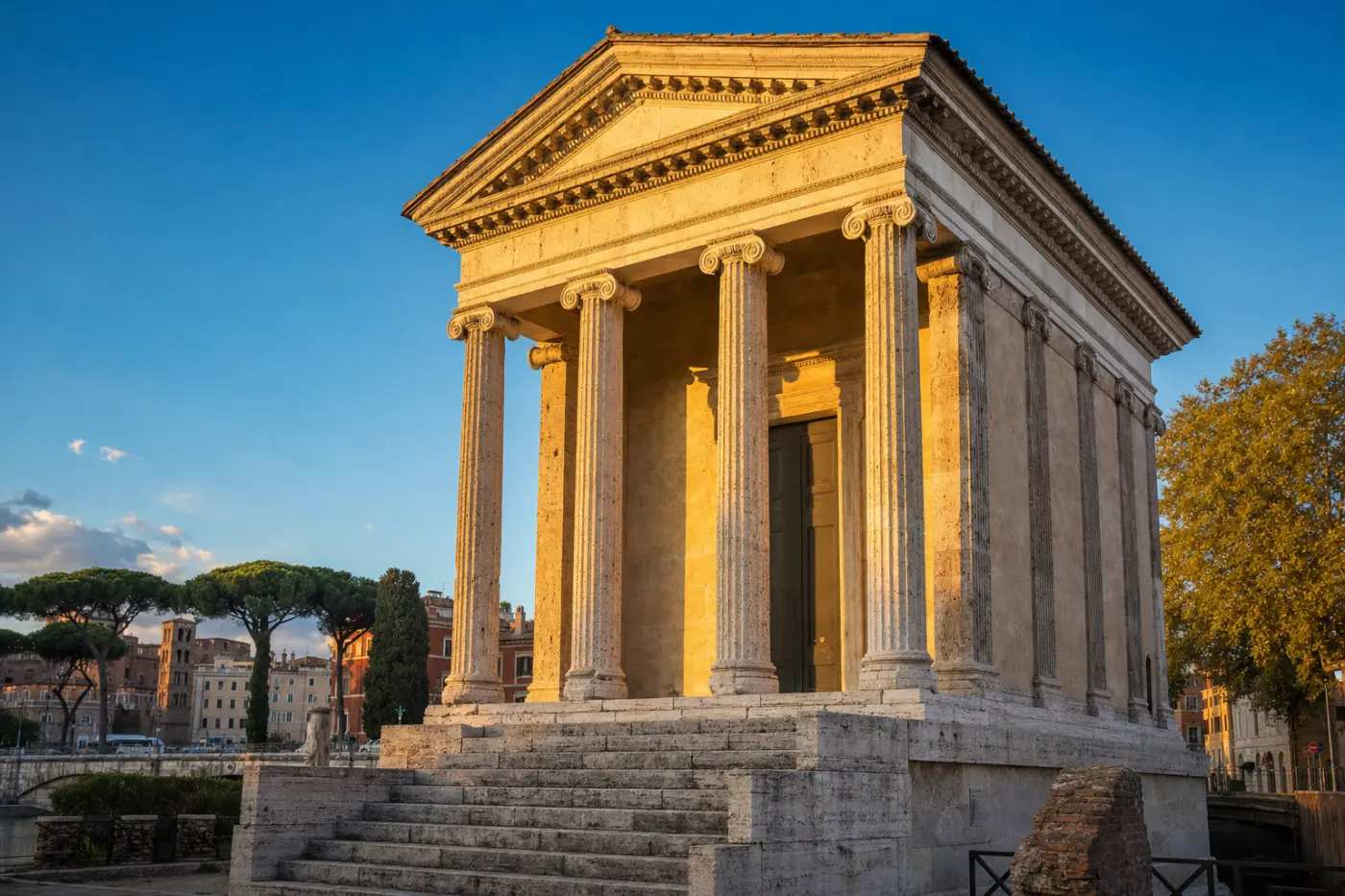
Tourist attraction
The Temple of Portunus is a remarkably intact ancient Roman temple standing in the Piazza della Bocca della Verità, just a short walk from the Tiber River in Rome's ancient Forum Boarium — the city's oldest cattle and commercial market. Dedicated to Portunus, the Roman god of ports, keys, and livestock, the temple dates to the 4th–3rd century B.C.E. in its earliest form, with the current structure rebuilt and refined during the late Republican period, around 100–80 B.C.E. Its survival over two millennia is largely owed to its conversion into a Christian church, Santa Maria Egyziaca, in 872 C.E., which protected it from the stone-robbing that destroyed so many other ancient monuments.
Architecturally, the temple is a textbook example of the Ionic order blended with Roman pseudo-peripteral design — a style in which freestanding columns appear only at the porch, while engaged (half-embedded) columns line the sides and rear of the cella wall, creating the visual impression of a fully colonnaded building. The structure measures roughly 30 by 15 meters and rests on a raised travertine podium with a single frontal staircase, a distinctly Roman departure from the Greek practice of steps on all sides. Its builders used local tuff and travertine stone, then coated the surface in stucco to mimic the gleaming appearance of Greek marble — a clever and common Republican-era technique. Four full Ionic columns mark the deep tetrastyle porch, while the flanking engaged columns display finely carved volute capitals.
What makes the Temple of Portunus especially compelling is the layered history written into its stones. The Forum Boarium where it stands was one of Rome's earliest urbanized zones, sitting at a strategic Tiber crossing point that made it a hub of trade and worship from at least the 7th century B.C.E. onward. The nearby Arch of Janus and the round Temple of Hercules Victor (long misidentified as the Temple of Vesta) stand just meters away, making this small piazza one of the densest concentrations of Republican-era monuments in the entire city. After its medieval conversion, the temple hosted frescoes inside the cella, fragments of which survived into the modern era before later conservation work stabilized what remained.
Visitors today can admire the temple's exterior freely from the piazza at any hour — it is viewable without a ticket and is particularly atmospheric at dusk when the warm travertine glow contrasts against the darkening sky. The piazza itself fronts the famous Bocca della Verità (Mouth of Truth) in the portico of Santa Maria in Cosmedin church, making this a natural combined stop. Rome's open-air character means the temple is best appreciated on a weekday morning before tour groups arrive. Though interior access is not regularly offered to the public, the exterior reveals extraordinary detail up close — look for the stucco remnants between the column flutes and the sharp, still-legible Ionic capitals that have withstood more than two thousand Roman winters.
Private tours with a local guide, at your own pace.
Rome
Rome
Rome
Rome

Rome
Rome
Rome
Rome
Rome

Rome
We use a single cookie, to remember this choice. We do not use analytics or advertising cookies. Read our cookie policy.