3 hrs
Rome
Rome: Private Walking Tour of Highlights & Secret Spots
✓ Free cancellation Kids friendly
5.0(27 reviews)
From €191/ person
Book Now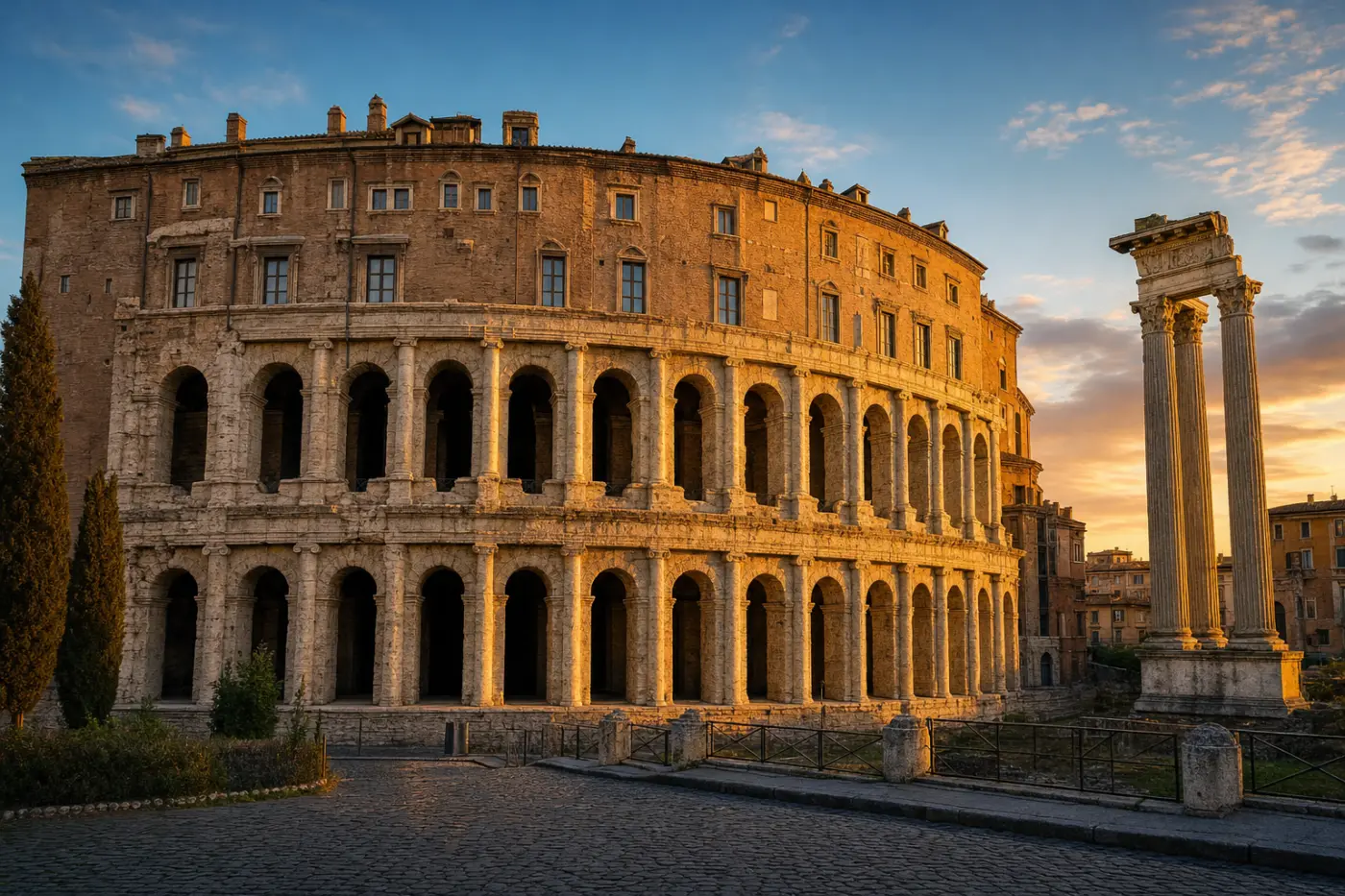
Tourist attraction
The Theatre of Marcellus (Teatro di Marcello) is the oldest surviving stone theatre in Rome and one of the most remarkable examples of ancient Roman architecture still standing in the city. Construction was begun by Julius Caesar, who cleared the site of earlier temples and structures to make way for it, but the theatre was completed and inaugurated by Emperor Augustus between 13 and 11 BC. Augustus dedicated it to his nephew and intended heir, Marcus Claudius Marcellus, who had died in 23 BC at just 20 years old. At the time of its inauguration, the theatre could seat between 11,000 and 20,000 spectators — a monumental scale that announced Rome's cultural and imperial ambitions to the ancient world. Its curved façade, articulated across two storeys with 41 arched openings framed by Doric columns on the lower level and Ionic columns on the upper, became a direct architectural model for the later Colosseum, built some 80 years afterward.
Through the medieval period, the theatre ceased to function as a performance venue and was progressively absorbed into the urban fabric of Rome. By the 12th century, the Fabi family and later the Savelli family had converted the massive stone skeleton into a fortified residence. In the 16th century, the architect Baldassarre Peruzzi was commissioned by the Savelli to design a Renaissance palazzo directly atop the ancient semicircular substructure — a palazzo that remains occupied today. The Orsini family acquired the property in the 17th century, and since the 20th century the upper storeys have housed private apartments, making the Theatre of Marcellus arguably the world's oldest continuously inhabited monument. Mussolini ordered the excavation of the surrounding area in the 1930s to isolate the structure as part of his broader campaign to link Fascist Rome symbolically to its imperial past, which is why the theatre stands so prominently today amid open space.
Visitors approaching from the Capitoline Hill immediately grasp the theatre's extraordinary layered biography: at ground level, three surviving arched bays of the original Roman scaenae rise in honey-coloured travertine, while Peruzzi's elegant Renaissance loggia crowns the top. Three columns from the adjacent Temple of Apollo Sosianus (rebuilt in 34 BC) stand just to the right of the theatre, adding another layer of ancient Rome to the scene. The area around the theatre is also home to remnants of the Porticus Octaviae, a monumental colonnade built by Augustus and dedicated to his sister Octavia, making this entire block one of the densest concentrations of ancient Roman remains in the city.
Because the Theatre of Marcellus is a privately owned residential building, the interior is not open to the public, but the exterior is freely accessible at all hours and best appreciated at dusk, when warm light catches the travertine arches. During summer, the site occasionally hosts outdoor classical music concerts in the shadow of the ancient walls — a continuation, in spirit, of the theatrical performances Augustus inaugurated here over two millennia ago. The theatre is located on Via del Teatro di Marcello, a short walk from the Roman Forum, the Capitoline Hill, and the Tiber Island, making it an easy and rewarding addition to any itinerary focused on ancient Rome.
Private tours with a local guide, at your own pace.
Rome
Rome
Rome

Rome

Rome
Rome
Rome

Rome
Rome

Rome
We use a single cookie, to remember this choice. We do not use analytics or advertising cookies. Read our cookie policy.