4 hrs
Rome
Rome Private Tour: Forum, Pantheon & Castel Sant’Angelo Tickets
✓ Free cancellation Kids friendly
5.0(14 reviews)
From €239/ person
Book NowTourist attraction
Trajan's Column is a free-standing triumphal column completed in 113 AD in the Forum of Trajan, the last and grandest of Rome's imperial fora. Commissioned by Emperor Trajan and almost certainly designed by the architect Apollodorus of Damascus, the monument stands approximately 38 meters (125 Roman feet) tall — a height that is said to correspond exactly to the depth of the ridge that was excavated to create the forum itself. The shaft is constructed from 20 drums of Luna marble, each weighing around 40 tons, and contains a hollow interior staircase of 185 steps that winds upward to a viewing platform at the summit.
Wrapping around the column's exterior in a continuous spiral are 155 individual relief scenes depicting Trajan's two military campaigns against the Dacians (101–102 AD and 105–106 AD), culminating in the Roman conquest of Dacia, roughly modern-day Romania. The frieze stretches approximately 200 meters in total length and contains over 2,500 individually carved figures — Trajan himself appears at least 58 times. It is one of the most detailed narrative artworks to survive from antiquity and remains a primary source for historians studying Roman military equipment, engineering, and campaign tactics. At the column's base, a golden urn once held the ashes of Trajan himself, making the monument simultaneously a war memorial and an imperial mausoleum. In 1588, Pope Sixtus V replaced the long-lost gilded bronze statue of Trajan at the summit with a bronze figure of St. Peter, which stands there to this day.
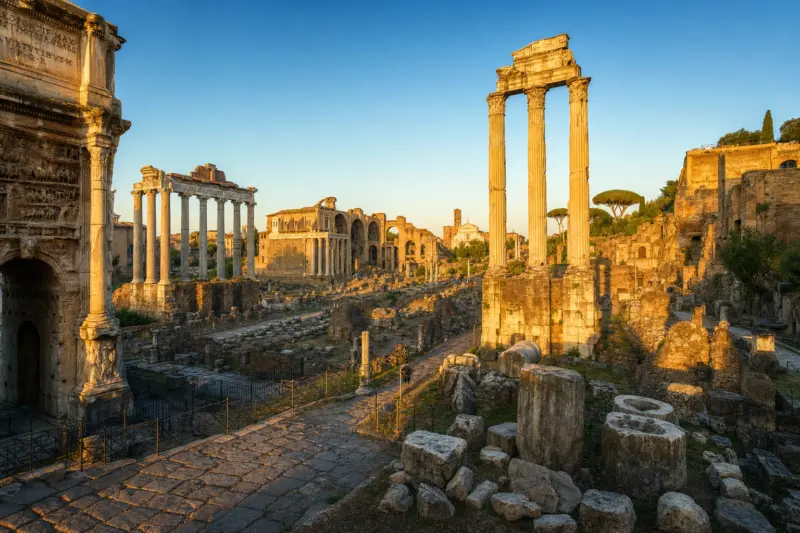
Visitors approaching the column enter Piazza della Madonna di Loreto, where the full vertical drama of the structure is immediately apparent. Standing at the base, you can trace the lowest bands of the frieze in detail — soldiers crossing the Danube on a pontoon bridge, Dacian warriors surrendering, Roman legionnaires constructing fortifications — before the upper scenes diminish in perspective against the sky. The reliefs were originally painted in vivid colors, and many scenes are subtly enlarged as they ascend to compensate for the viewing angle from ground level, a sophisticated optical trick. The Forum of Trajan surrounding the column, inaugurated in 112 AD, also contains the remains of the Basilica Ulpia and the foundations of two flanking libraries — one Greek, one Latin — between which the column originally stood, so that readers exiting either library would look directly at the frieze at eye level from the upper gallery windows.
The column is visible at all hours and admission to the surrounding archaeological zone is free from street level. For the closest views, position yourself in Piazza della Madonna di Loreto or along Via dei Fori Imperiali, which runs directly past the site. The nearby Museo dei Fori Imperiali, housed inside Trajan's Markets, displays plaster cast reproductions of the entire frieze at walkable height, making it the essential companion visit for anyone who wants to read the full narrative in detail. Early morning light from the east illuminates the east-facing reliefs most dramatically; late afternoon casts the spiral in sharp relief shadow. The column is a ten-minute walk from the Colosseo metro station (Line B).
Private tours with a local guide, at your own pace.
Rome
Rome

Rome

Rome

Rome
Rome
Rome

Rome

Rome
We use a single cookie, to remember this choice. We do not use analytics or advertising cookies. Read our cookie policy.