3 hrs
Rome
Private Cooking Class with Colosseum Views and Local Chef
✓ Free cancellation Kids friendly
4.7(19 reviews)
From €223/ person
Book Now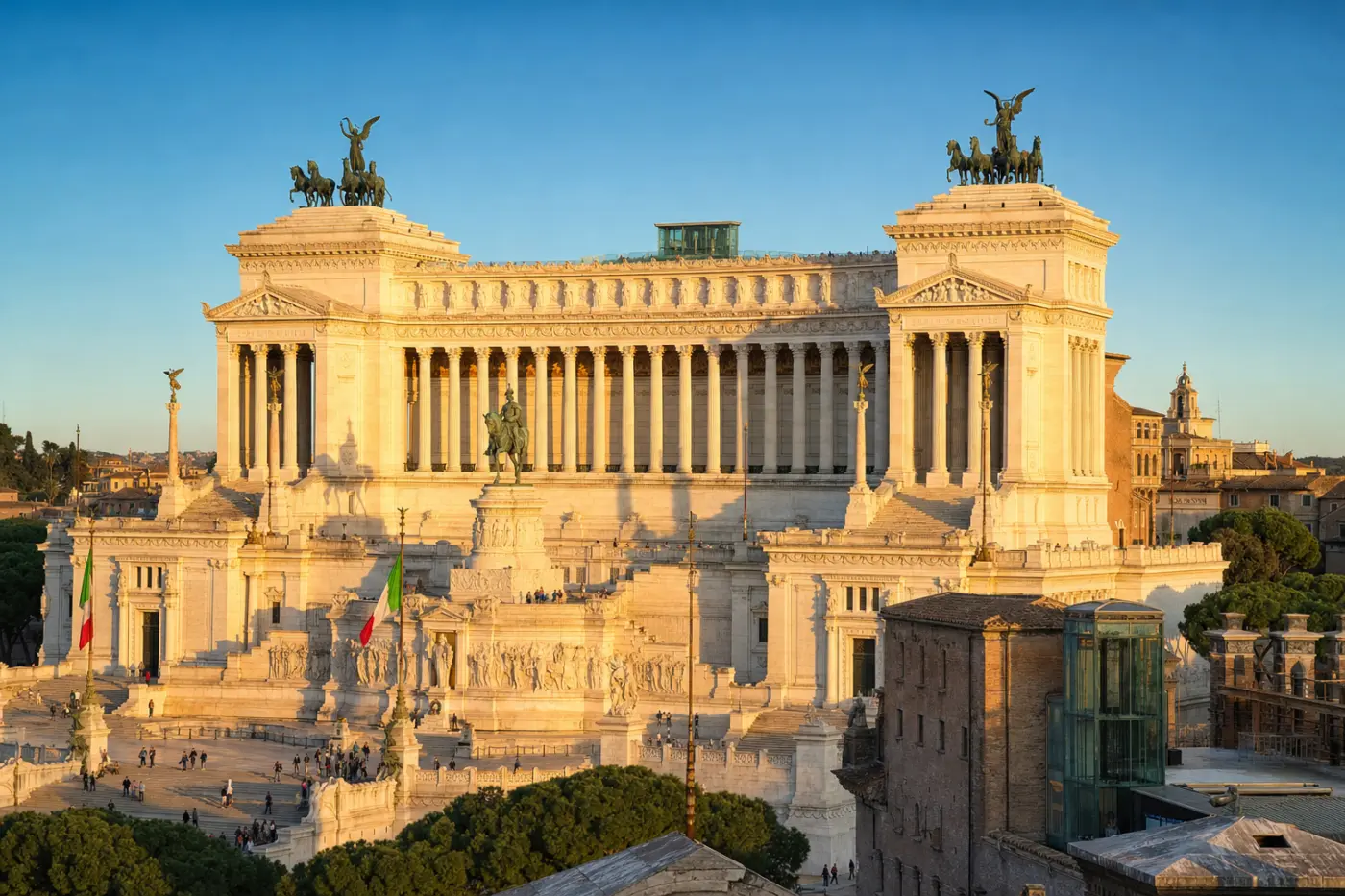
Tourist attraction
The Vittoriano — formally the Monumento Nazionale a Vittorio Emanuele II and popularly nicknamed the "Wedding Cake" or "Typewriter" for its tiered white silhouette — dominates Piazza Venezia at the foot of the Capitoline Hill. Designed by architect Giuseppe Sacconi, whose project was selected in 1885 after a national competition, construction consumed nearly four decades before the monument was inaugurated in 1911 for the fiftieth anniversary of Italian Unification, with final completion in 1925. Sacconi's design drew deliberate inspiration from ancient Greek sanctuary architecture, particularly the Pergamon Altar and the Sanctuary of Fortuna Primigenia at Palestrina, composing the structure as a vast raised terrace lined with colonnades. To build it, significant medieval remains on the Capitoline Hill's northern slope were demolished — a decision that remains controversial among Roman historians to this day. The gleaming exterior is clad in Botticino marble quarried near Brescia in northern Italy, chosen over Rome's traditional travertine limestone because of its finer grain and workability; its brilliant whiteness, striking against the ochre and terracotta of surrounding Rome, is the very reason for the monument's irreverent nicknames.
At the monument's symbolic heart sits the Altare della Patria — the Altar of the Fatherland — positioned at the top of the 196-step central staircase directly beneath a mosaic depicting the goddess Roma on a gilded background. The altar was sculpted by Angelo Zanelli and flanks the equestrian statue of King Victor Emmanuel II, a bronze colossus so large that fourteen people once sat inside the horse's belly during its assembly. Guarding the base of the monument is the Tomb of the Unknown Soldier, inaugurated on 4 November 1921, Italy's National Unity and Armed Forces Day. A flame burns perpetually at the tomb, watched over around the clock by an honor guard from the Italian Army — one of Rome's most quietly moving ceremonies, performed in continuous rotation every day of the year. The monument also houses the Museo del Risorgimento (Museum of Italian Unification), whose collection of documents, uniforms, weapons, and paintings traces the entire arc of the Risorgimento from the Napoleonic period through the proclamation of the Kingdom of Italy in 1861.
Visitors climb the 196 marble steps free of charge and emerge onto a broad intermediate terrace where the scale of Zanelli's sculptural program becomes fully apparent — two quadrigae (four-horse bronze chariots) crown the uppermost colonnades, representing Liberty and Unity. For an even more commanding perspective, a ticketed elevator ascends to the very top of the monument's roof, the so-called Quadriga Terrace, delivering a 360-degree panorama that sweeps from the Pantheon and the Borghese pines to the Colosseum, the Roman Forum, and the distant dome of St. Peter's Basilica. Unlike the paid terraces at St. Peter's or the Pincio, this rooftop view is notably free of obstructions and positions the viewer directly above the historic center — it is widely considered the single most complete panoramic vantage point over Rome.
Entry to the monument and its intermediate terraces is free; the elevator to the summit terrace carries a modest fee (around €7 as of recent years) and operates until shortly after sunset, making it an exceptional spot for golden-hour photography. The museum inside is also free and often uncrowded even when the exterior is busy. The monument sits steps from the Roman Forum, the Capitoline Museums, and the Circus Maximus, making it a natural anchor for a full day in ancient Rome. Dress modestly — shorts and bare shoulders are generally tolerated here as it is a civic rather than a religious site — and arrive early on weekends to avoid the longest queues at the elevator.
Private tours with a local guide, at your own pace.
Rome
Rome
Rome
Rome
Rome
Rome
Rome
Rome