3 hrs
London
London: Private Family Tour, Natural History Museum & Games
✓ Free cancellation Kids friendly
4.5(0 reviews)
From €208/ person
Book Now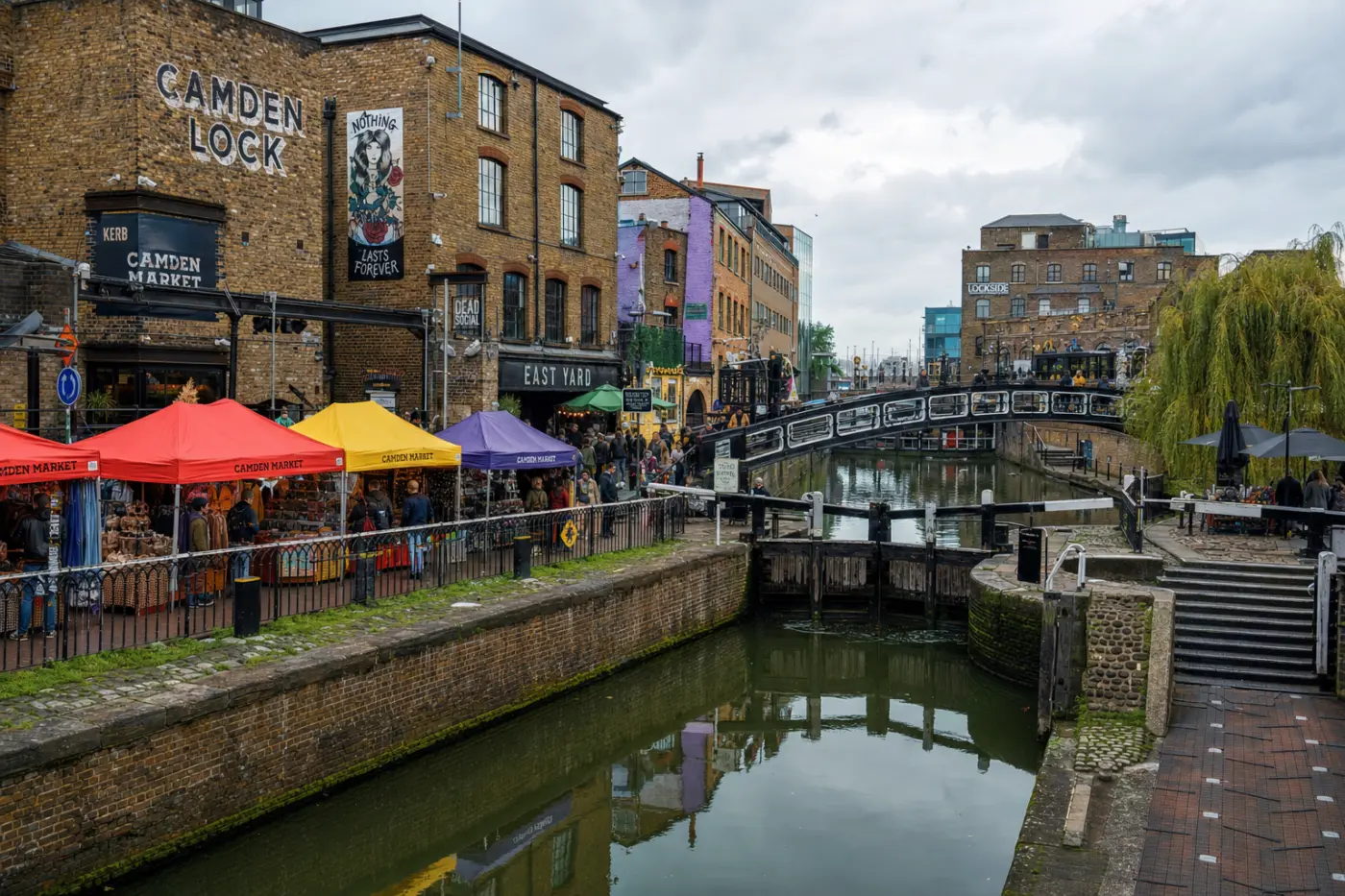
Tourist attraction
Camden Market is a sprawling network of six interconnected market areas clustered along the Regent's Canal in Camden Town, north London. It began on March 30, 1974, when just 16 traders set up stalls selling antiques, jewellery, and handmade crafts in the derelict T.E. Dingwall builders' yard beside Camden Lock. The site was earmarked for demolition — a proposed urban motorway called the North Cross Route was intended to cut straight through it — which meant only a temporary market was viable. When those motorway plans were scrapped in 1976, Camden Lock Market had already embedded itself into the neighbourhood's identity. Today it draws roughly 250,000 visitors each week, making it London's fourth-most-visited attraction.
The ground beneath the market carries centuries of industrial history. The Regent's Canal reached Camden in 1816, transforming the area into a canal terminus complete with warehouses, basins, and an 80-foot ice well. The removals firm Pickfords stabled around 800 working horses on the site, shuttling goods between canal barges and the London & Birmingham Railway — Britain's first intercity line. A network of underground tunnels was dug specifically so the horses could move safely beneath the busy marshalling yards; the last of those horses retired in 1967, leaving the Victorian stable buildings empty. By 1985, market traders had taken over those very stalls: the Stables Market, built directly inside the former Pickfords horse stables, became one of Camden's most atmospheric sub-markets. The wine and spirits importer W&A Gilbey also operated out of Camden Goods Station in the 19th century, and gin warehouses once occupied several of the canal-side buildings that now house street food vendors and record shops.
Camden's cultural gravity intensified through the late 1970s and 1980s, when Sunday trading laws barred most UK shops from opening on Sundays but exempted market stalls. That legal loophole made Camden one of the only places in London to browse on a Sunday, and the punk and post-punk scenes that were reshaping British youth culture found a natural home among its independent vendors. Designer Wayne Hemingway was among the early traders. The market became a launchpad for alternative fashion labels and independent musicians, cementing its reputation as the beating heart of London's counterculture. Today, the six sub-markets — Camden Lock, the Stables, Buck Street, Camden Lock Village, the Electric Ballroom market, and Inverness Street — stretch across a Victorian industrial landscape of lock gates, iron bridges, and cobbled yards that no retail development could replicate.
Visitors should arrive early on weekdays to navigate the indoor market halls and canal-side stalls without weekend crowds; Saturday and Sunday bring the full spectacle but also the full 250,000. The nearest Underground station is Camden Town on the Northern line, a two-minute walk from the main market entrance on Camden High Street. Street food at the Hawley Wharf section ranges from Eritrean injera to Japanese takoyaki, and the view along the Regent's Canal toward the lock is best captured from the iron footbridge at Camden Lock itself. Comfortable shoes are essential — the cobbled stable yards and multi-level Stables Market involve significant walking across uneven ground.
Private tours with a local guide, at your own pace.
London
London

London
London
London
London
London

London