3 hrs
London
London: Private Family Tour, Natural History Museum & Games
✓ Free cancellation Kids friendly
4.5(0 reviews)
From €208/ person
Book Now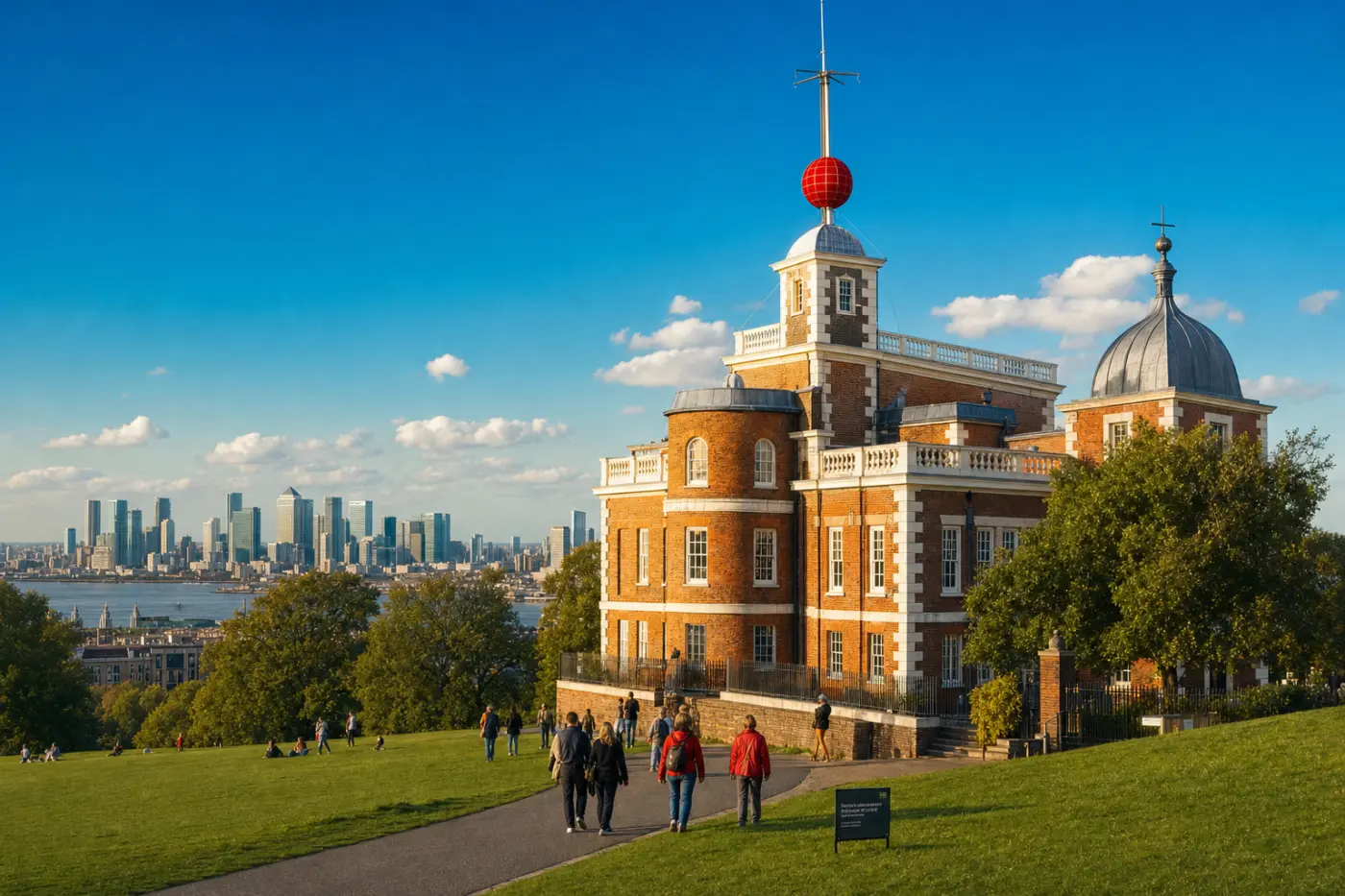
Tourist attraction
Perched on the highest hill in Greenwich Park, the Royal Observatory is Britain's oldest purpose-built scientific institution, founded on 22 June 1675 by order of King Charles II. The king commissioned it for an urgently practical reason: British sailors could calculate their latitude using the Sun and stars, but had no reliable method to determine longitude — their east-west position — once out of sight of land. Charles II appointed John Flamsteed as the first "Astronomical Observator" (later known as Astronomer Royal) on 4 March 1675, and tasked architect Christopher Wren — then a former Oxford professor of astronomy, not yet the celebrated designer of St Paul's Cathedral — with designing the buildings alongside Robert Hooke. Wren repurposed the solid foundations of the ruined Greenwich Castle on the hilltop, keeping costs to a minimum while securing a commanding, clear-sky site already owned by the Crown.
The Observatory's scientific legacy is woven into every clock and GPS device on the planet. Flamsteed spent decades making painstakingly systematic measurements of the positions of the Sun, Moon, stars, and planets, understanding that only long-term, repeated observations could reveal the precise lunar motions needed to solve the longitude problem. That solution eventually came in two forms: the lunar-distance method, perfected using Greenwich star tables, and the marine chronometer, famously developed by John Harrison. In 1884, delegates from 25 nations met in Washington D.C. and voted to make the Greenwich Meridian — the line running through the Observatory's Airy Transit Circle telescope — the world's Prime Meridian, establishing 0° longitude and the foundation of global time zones. Greenwich Mean Time, tracked here for centuries, became the baseline from which all world time is measured.
Today the site is part of the UNESCO Maritime Greenwich World Heritage Site, a designation awarded in 1997 that also encompasses the Painted Hall at the Old Royal Naval College and the tea clipper Cutty Sark on the riverfront below. Visitors can straddle the famous brass Meridian Line in the courtyard — the literal divide between the Eastern and Western hemispheres — and watch the red Time Ball on the Observatory roof drop at 13:00 daily, a signal that has been used to set ships' chronometers since 1833. Inside, Flamsteed House contains the spectacular 17th-century Octagon Room designed by Wren, while the Peter Harrison Planetarium hosts live astronomy shows beneath London's only public digital star projector.
To make the most of the visit, arrive early to claim the Meridian courtyard before the midday crowds gather for the Time Ball drop. Combine the Observatory with the Cutty Sark and the National Maritime Museum — all free or included under one ticket — by walking downhill through Greenwich Park, whose formal avenues were laid out in the 1660s by French landscape designer André Le Nôtre. The DLR to Cutty Sark station or the Thames Clipper river service to Greenwich Pier are the most scenic approaches from central London. Comfortable shoes are essential: the climb from the park gates to the hilltop is steep but rewards with a panoramic view across the Thames to Canary Wharf and the City beyond.
Private tours with a local guide, at your own pace.
London
London

London
London
London
London
London
London