3 hrs
London
London: Private Family Tour, Natural History Museum & Games
✓ Free cancellation Kids friendly
4.5(0 reviews)
From €208/ person
Book Now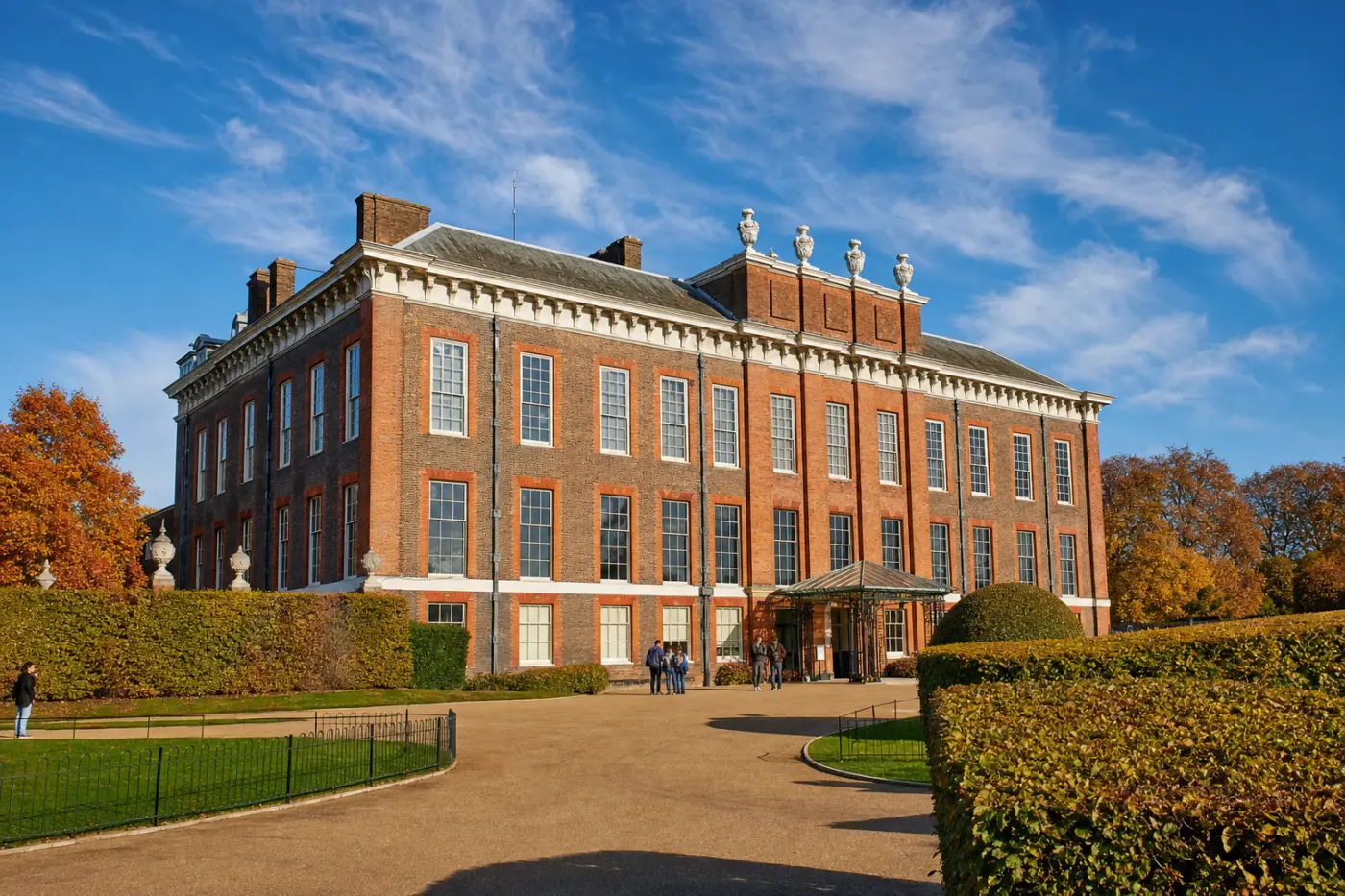
Tourist attraction
Kensington Palace began not as a royal showpiece but as a modest Jacobean mansion known as Nottingham House, purchased in 1689 by King William III for £18,000. Suffering from asthma aggravated by the damp air near Whitehall, William commissioned Sir Christopher Wren to expand and remodel the property — a transformation completed in stages through the 1690s. The palace was further enlarged under King George I, who hired Colen Campbell and William Kent between 1718 and 1727 to redesign the King's State Apartments. Kent's elaborate trompe-l'œil ceiling in the King's Staircase, completed in 1726, remains one of the finest examples of Baroque illusionism in England, depicting dozens of figures from the Georgian court arranged on a painted colonnade. The palace served as the principal royal residence until King George II's death there in 1760, after which the court shifted permanently to Buckingham Palace.
The palace's most consequential role may be as the birthplace and childhood home of Queen Victoria. Born within its walls on 24 May 1819, Victoria was raised here under the strict "Kensington System" devised by her mother the Duchess of Kent and the ambitious courtier Sir John Conroy — a regime designed to keep the young princess isolated and dependent. It was in her bedroom at Kensington that the 18-year-old Victoria received the Archbishop of Canterbury and the Lord Chamberlain at 6 a.m. on 20 June 1837, learning she had become Queen of England following King William IV's death. Visitors today can stand in that very room, the Red Saloon, now restored to its appearance on that pivotal morning. In the 20th century, the palace became internationally known as the London home of Diana, Princess of Wales, who lived in Apartments 8 and 9 from her marriage to Prince Charles in 1981 until her death in 1997. The gates outside became a defining site of national mourning, blanketed with flowers that stretched for hundreds of metres in the days following her death on 31 August 1997.
Today Kensington Palace is managed by Historic Royal Palaces and is open to the public year-round. The visitor experience centres on several permanent exhibitions set within the restored State Apartments. The King's and Queen's State Apartments showcase the original Baroque interiors, with Kent's painted ceilings and Queen Mary II's collection of blue-and-white Delftware still in situ. The permanent "Victoria Revealed" exhibition presents over 200 personal objects drawn from the Royal Collection, tracing the queen's life from her isolated Kensington childhood to her 63-year reign. A rotating programme of temporary exhibitions — often focusing on royal fashion or 20th-century royal life — frequently draws on Diana's legacy and personal wardrobe.
The palace sits at the western edge of Kensington Gardens, itself a 111-hectare royal park, making a combined visit straightforward. The Sunken Garden, created in 1908 and replanted with white flowers as a tribute to Diana in 2017, lies immediately adjacent to the palace's south facade and is freely accessible without a ticket. The nearest Underground station is High Street Kensington (District and Circle lines) or Queensway (Central line), both a roughly ten-minute walk through the park. Pre-booking tickets online via the Historic Royal Palaces website is strongly recommended, particularly between April and September, as timed entry slots fill quickly. Allow at least two to three hours to do the State Apartments justice.
Private tours with a local guide, at your own pace.
London
London
London
London
London
London
London
London