3 hrs
London
London: Private Family Tour, Natural History Museum & Games
✓ Free cancellation Kids friendly
4.5(0 reviews)
From €208/ person
Book Now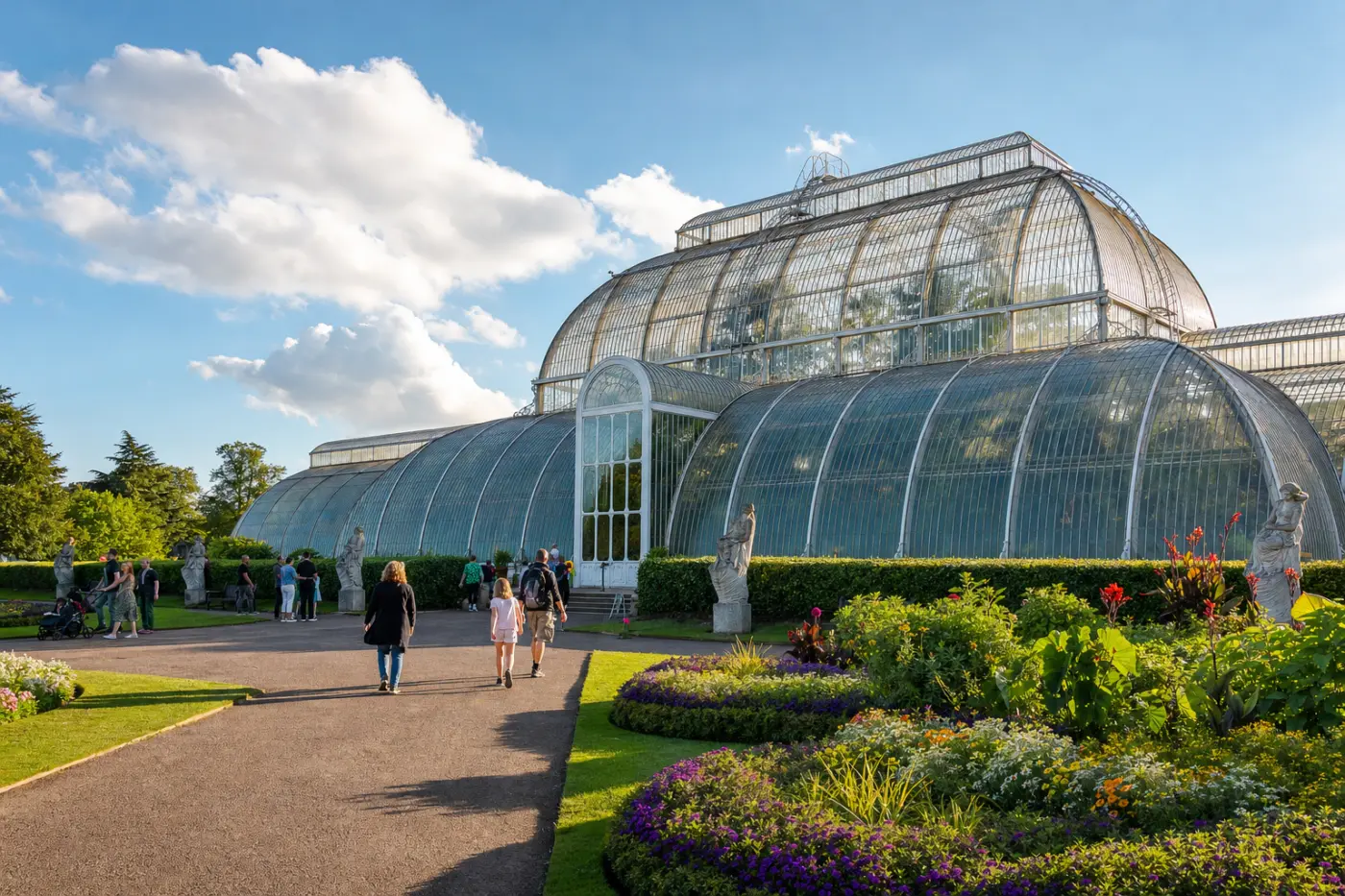
Tourist attraction
The Royal Botanic Gardens, Kew — universally known as Kew Gardens — sprawl across 132 hectares on the south bank of the Thames between Richmond and Kew in southwest London. The site's plural name is no accident: it reflects the two distinct royal estates that were gradually merged here. King George II and Queen Caroline resided at Ormonde Lodge on the Richmond estate, while their son Prince Frederick leased the neighbouring Kew estate in the 1730s. After Frederick's death in 1751, his widow Princess Augusta established a modest 9-acre botanic garden with the help of Lord Bute and architect William Chambers, who gave the grounds several of their defining structures — the Orangery, the Ruined Arch, and, most dramatically, the 49-metre Great Pagoda completed in 1762. George III then inherited the Richmond estate in 1760 and the Kew estate upon his mother's death in 1772, uniting the two properties and setting the foundation for what would become the world's foremost centre of botanical science.
The scientific ambition of Kew expanded rapidly through the 19th century. Under the directorship of Sir William Hooker, appointed in 1841, the gardens were opened to the public and a programme of landmark glasshouses began. The Palm House, completed in 1848 to designs by Decimus Burton and engineer Richard Turner, is Kew's most iconic structure — a sweeping iron-and-glass cathedral housing tropical palms, some of which are over 200 years old. The even larger Temperate House, also designed by Burton and completed in stages between 1862 and 1899, is the world's largest surviving Victorian glasshouse and shelters plants from every temperate region of the globe, including a Chilean wine palm planted in 1846 that now stands 16 metres tall. In 2003 UNESCO inscribed the gardens as a World Heritage Site, recognising their outstanding influence on botany, horticulture, and landscape design over more than 250 years.
Today Kew's living collections encompass over 50,000 plant species and its herbarium holds 7 million dried specimens, making it the single largest and most diverse botanical and mycological repository on Earth. Visitors can follow the 18-metre-high Treetop Walkway through the forest canopy, descend into the subterranean Hive installation — a 17-metre aluminium structure that vibrates in synchrony with a real Kew beehive — or explore the Waterlily House, which shelters the giant Victoria amazonica with leaves capable of supporting the weight of a child. The Shirley Sherwood Gallery of Botanical Art, opened in 2008, is the world's first gallery dedicated permanently to botanical illustration and displays works dating back to the 17th century.
Kew is open every day of the year except Christmas Eve and Christmas Day; hours vary seasonally, with the gardens staying open later during summer evenings. The nearest London Underground station is Kew Gardens on the District line, and the gardens are also accessible by Thames River boat from Westminster Pier. Spring draws visitors for the bluebells and the cherry blossom avenue, while the annual Christmas at Kew light trail transforms the grounds each winter. Comfortable walking shoes are strongly advised — covering the full site means several kilometres on foot — and a printed map from the main gate helps prioritise given the scale of the collections.
Private tours with a local guide, at your own pace.
London
London
London
London
London
London
London
London