3 hrs
London
London: Private Family Tour, Natural History Museum & Games
✓ Free cancellation Kids friendly
4.5(0 reviews)
From €208/ person
Book Now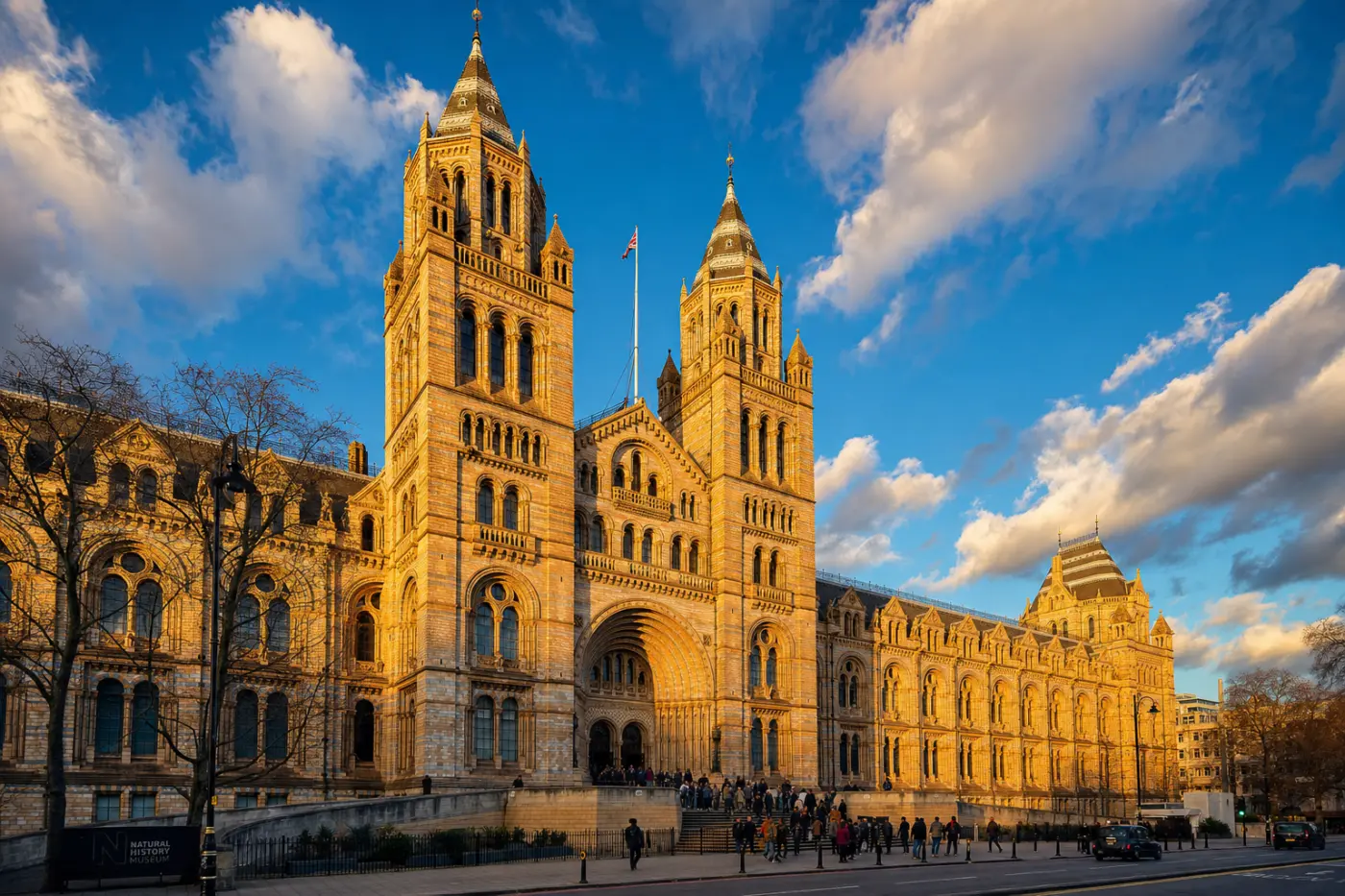
Tourist attraction
The Natural History Museum in South Kensington is one of the world's foremost scientific institutions, holding a collection of 80 million items across five disciplines: botany, entomology, mineralogy, palaeontology, and zoology. Its origins trace to 1753, when Parliament purchased physician and collector Sir Hans Sloane's personal collection of more than 71,000 natural history specimens and cultural artefacts for £20,000 — well below its estimated value — and housed it within the newly established British Museum. It was Sir Richard Owen, the natural scientist who coined the term "dinosaur," who in 1856 campaigned for a dedicated building to accommodate the collection's relentless growth. Owen envisioned what he called a "cathedral to nature," accessible free of charge to everyone.
That cathedral took physical form through architect Alfred Waterhouse, whose Romanesque Revival building opened on 18 April 1881. Waterhouse clad the entire facade in terracotta tiles — a practical choice that resists London's sooty atmosphere — and decorated every surface with sculpted animals and plants, making the architecture itself a taxonomic statement. Twin towers flank the central entrance arch, rising 52 metres, and the interior's central hall is modelled on a Romanesque nave, with ornate columns and gilded ceiling panels. The museum operated as a department of the British Museum until 1963, when it received its own board of trustees, though it was not formally renamed the Natural History Museum until 1992.
Inside, the 25-metre blue whale skeleton known as "Hope" has hung from the ceiling of Hintze Hall since 2017, replacing the diplodocus cast nicknamed "Dippy" that greeted visitors for nearly 35 years. Hope was acquired by the museum in 1891 and is among the most photographed subjects in London. Beyond Hope, the Vault gallery displays meteorites billions of years old and a 296-carat Sri Lankan sapphire, while the Darwin Centre houses 17 million preserved insects and 3 million botanical specimens in a climate-controlled cocoon building completed in 2009. The museum also hosts the annual Wildlife Photographer of the Year competition, the world's most prestigious nature photography award, which it has run since 1965.
Admission to the permanent collection is free, though ticketed special exhibitions run year-round. The museum opens daily from 10:00 to 17:50, with last entry at 17:30; it is closed on 24–26 December. The closest Underground station is South Kensington on the District, Circle, and Piccadilly lines, a five-minute walk via the Exhibition Road tunnel. Visiting on a weekday morning significantly reduces queues at the entrance. The Wildlife Garden on the museum's western grounds, established in 1995, is open from March through October and contains over 2,000 species of plants and invertebrates — an often-overlooked counterpart to the galleries inside.
Private tours with a local guide, at your own pace.
London
London
London
London
London
London
London
London