3 hrs
London
London: Private Family Tour, Natural History Museum & Games
✓ Free cancellation Kids friendly
4.5(0 reviews)
From €208/ person
Book Now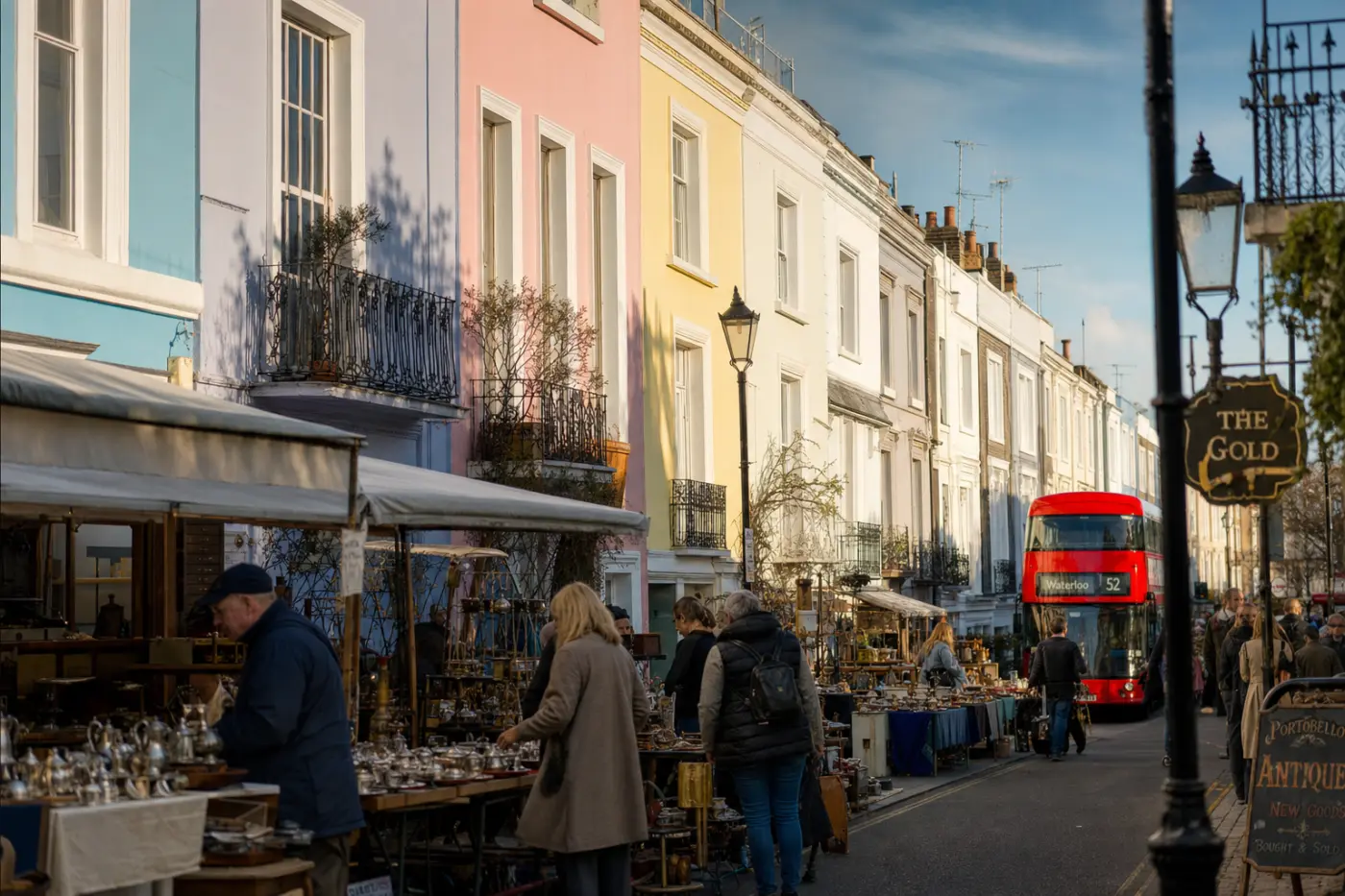
Tourist attraction
Notting Hill sits within the Royal Borough of Kensington and Chelsea in west London, occupying a gentle rise that — according to local etymology — was once crowned with nut trees. In the early 19th century the area was still largely rural farmland and orchards on the outskirts of the city. By the 1840s and 1850s, rapid urbanisation had transformed it into a dense working-class district tied to brick-making and pottery production, attracting waves of Irish and, later, Afro-Caribbean immigrants whose cultural imprint defines the neighbourhood to this day. Those mid-century overcrowded conditions gave way through the 20th century to a gradual gentrification that by the 1990s had turned Notting Hill into one of London's most desirable — and expensive — postcodes.
The neighbourhood's most vivid annual expression of its Caribbean heritage is the Notting Hill Carnival, launched in 1966 by Trinidadian activist Claudia Jones as a direct response to the racial tensions that had erupted in the 1958 Notting Hill race riots. Held every August Bank Holiday weekend, the Carnival now draws over two million people across two days, making it Europe's largest street festival. Steel pan orchestras, elaborately costumed masquerade bands, and the scent of jerk chicken and roti fill the streets of Ladbroke Grove and Westbourne Park Road in a celebration rooted in Trinidad's pre-Lenten Carnival tradition. The event is both a political statement and a joyful affirmation of the community that built it.
Portobello Road Market, stretching roughly 1.2 kilometres from Notting Hill Gate northward to Golborne Road, has operated as a market since the 1860s, originally selling herbs and horses. Today it is structured in distinct sections: antiques and silver cluster around the southern end near Chepstow Villas on Saturdays; vintage clothing and independent fashion fill the arcades under the Westway flyover; and fresh produce stalls have traded daily near the northern end for generations. The 1999 Richard Curtis film starring Hugh Grant and Julia Roberts fixed the market's blue-fronted travel bookshop (at 142 Portobello Road, used as a filming location) in the global imagination, generating a tourism pilgrimage that continues decades later.
Walking the neighbourhood rewards slow exploration. The pastel-coloured stucco terraces of Lansdowne Road, Stanley Gardens, and Pembridge Villas — painted in ice cream shades of primrose, cobalt, and coral — date largely from the 1850s and 1860s and were built speculatively as middle-class housing. The Electric Cinema on Portobello Road, opened in 1910 and one of the UK's oldest working picture houses, still screens films to audiences seated in leather armchairs and double sofas. For market visits, Saturday mornings before 10 a.m. offer the fullest antiques spread with fewer crowds; the market is quietest on weekdays. The nearest Underground stations are Notting Hill Gate (Central, Circle, and District lines) and Ladbroke Grove is served by local buses.
Private tours with a local guide, at your own pace.
London
London
London
London
London
London
London
London