3 hrs
London
London: Private Family Tour, Natural History Museum & Games
✓ Free cancellation Kids friendly
4.5(0 reviews)
From €208/ person
Book Now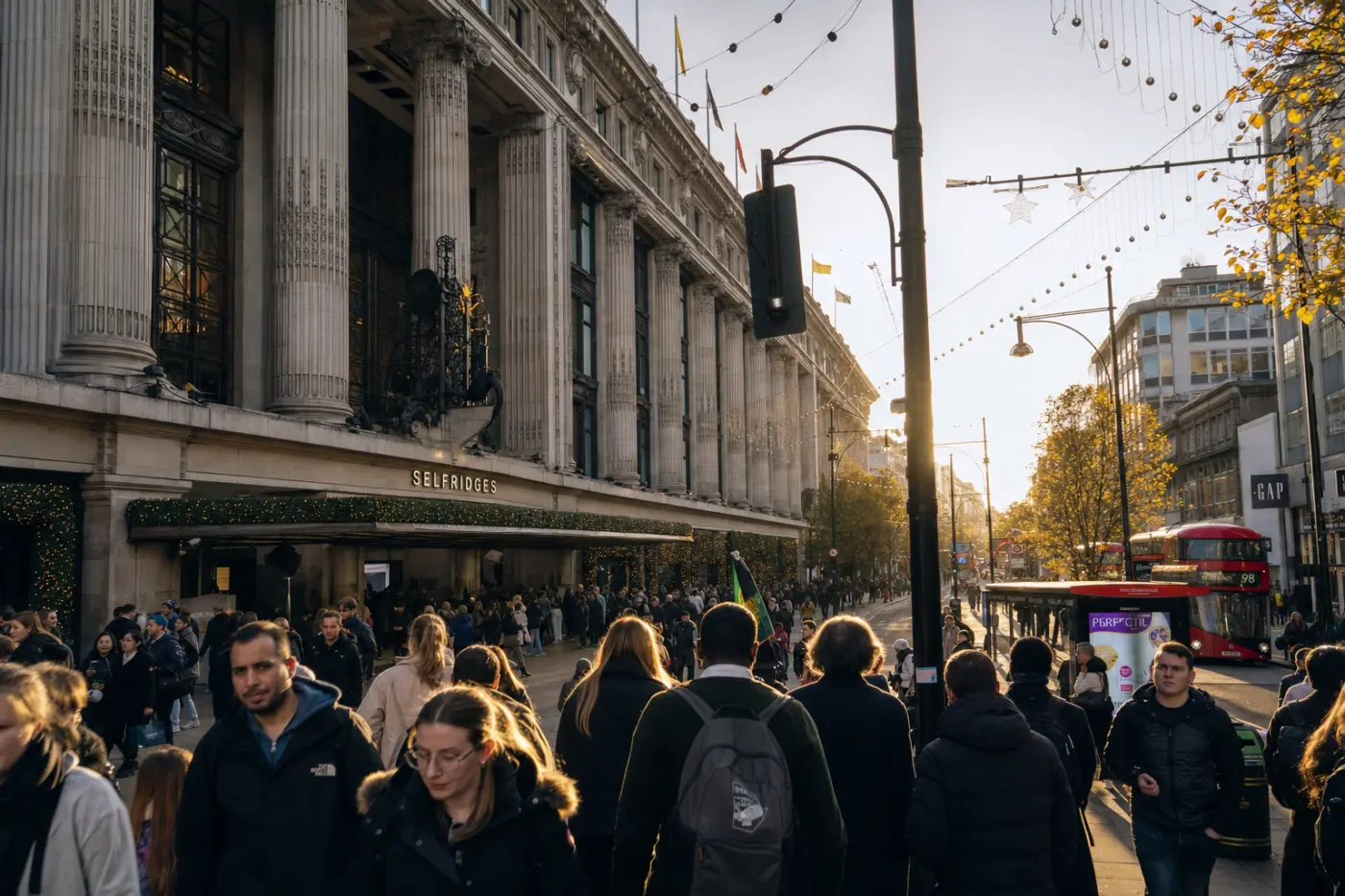
Tourist attraction
Oxford Street follows the course of the Via Trinobantina, a Roman road that once linked Colchester to Hampshire, making the ground beneath your feet more than 2,000 years old. For centuries it was known as Tyburn Road, named after the now-buried Tyburn River that still flows beneath it, and it served a grimly functional purpose: condemned prisoners were marched along its entire length from Newgate Prison to the Tyburn Tree, a triangular gallows at what is now Marble Arch, where public hangings drew enormous crowds well into the 18th century. A small stone at the northeast corner of Marble Arch still marks the exact spot where the gallows stood — one of London's most overlooked historical markers, passed daily by thousands of shoppers who never notice it.
The street's transformation into a retail destination began in earnest in the 19th century, but its defining moment came in 1909 when Harry Gordon Selfridge, an American entrepreneur from Wisconsin, opened Selfridges at 400 Oxford Street. Selfridge revolutionised British retail by treating shopping as an experience rather than a transaction — he introduced ground-floor perfume counters, theatrical window displays, and a rooftop garden. Today the building retains its original Portland stone neoclassical facade, with the iconic Queen of Time sculpture presiding over the main entrance. John Lewis arrived at its current Oxford Street address in 1864, and the street gradually accumulated the density of international flagship stores that earns it its modern superlative: the busiest shopping street in Europe, drawing approximately 200 million visitors per year across its 1.2 miles and roughly 300 shops.
The street runs west to east from Marble Arch to Tottenham Court Road, anchored at its midpoint by Oxford Circus, where Regent Street crosses at a right angle. Oxford Circus itself was redesigned in 2009 to include a diagonal pedestrian crossing — one of only a handful in the UK — allowing all four corners to be reached simultaneously. The western stretch toward Marble Arch tends to house international fast-fashion chains, while the eastern end near Tottenham Court Road skews toward electronics and is bookended by the flagship stores of John Lewis and the redeveloped former BHS site. The northern side of the street at the Selfridges block is especially worth examining for its Ionic columns and sculptural decoration.
Practically speaking, Oxford Street has four Underground stations along its length — Marble Arch, Bond Street, Oxford Circus, and Tottenham Court Road — all served by the Elizabeth line at the latter two, cutting journey times from across London significantly since its 2022 opening. The street is pedestrian-heavy at all times but reaches peak congestion on Saturday afternoons and throughout December. For a less crowded visit, weekday mornings before 11am are markedly quieter. The side streets immediately north and south — including South Molton Street, St Christopher's Place, and the covered Argyll Arcade — offer independent shops and cafés that provide a useful escape from the main thoroughfare's intensity.
Private tours with a local guide, at your own pace.
London
London

London
London
London

London
London
London