3 hrs
London
London: Private Family Tour, Natural History Museum & Games
✓ Free cancellation Kids friendly
4.5(0 reviews)
From €208/ person
Book Now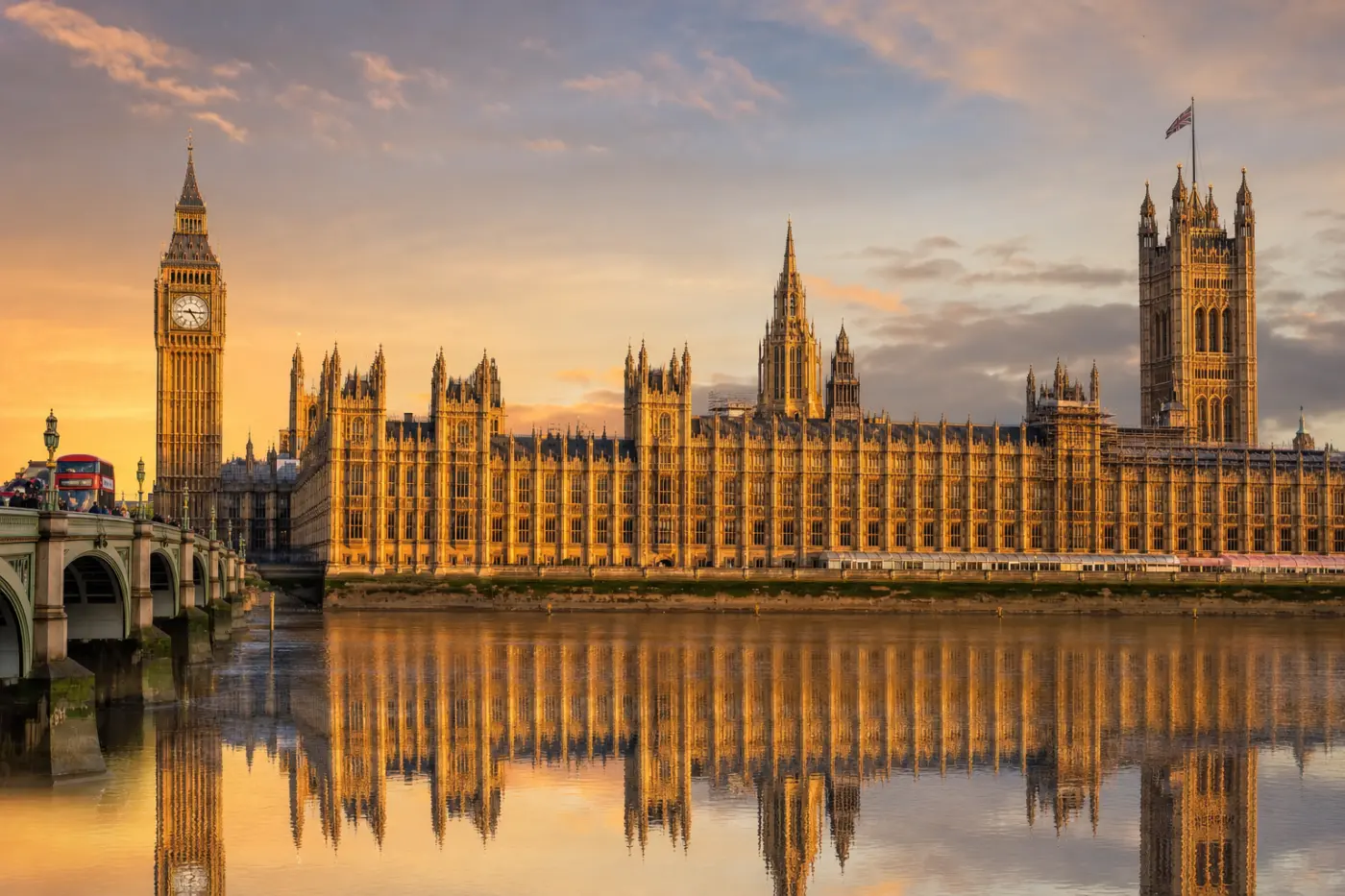
Tourist attraction
The Palace of Westminster occupies a site with a political and spiritual history stretching back over a millennium. King Cnut built a royal palace here in the early 11th century on Thorney Island — a raised spit of land in the River Tyburn — and Edward the Confessor later made it his principal residence, situating it alongside the Benedictine abbey he was rebuilding from the 1040s onward. Parliament first met here in 1265 under Simon de Montfort, and by the 16th century, after Henry VIII relocated the royal court to Whitehall, the complex became the permanent seat of the legislature. Westminster Hall, begun by William Rufus in 1097 and given its magnificent hammerbeam oak roof by Richard II between 1393 and 1401, is the oldest surviving structure on the site and one of the finest medieval interiors in Europe.
On the night of 16 October 1834, overheated furnaces used to burn old tally sticks ignited the medieval buildings, and the resulting fire consumed nearly the entire palace in a blaze watched by thousands of Londoners, including the artist J.M.W. Turner. A competition for the replacement stipulated a Gothic or Elizabethan design to harmonise with Westminster Abbey and the surviving Westminster Hall. Architect Sir Charles Barry won the commission, and he brought in Augustus Welby Northmore Pugin — the era's foremost Gothic Revival theorist — to design the intricate decorative programme. Construction ran from 1840 to 1870, producing a building of over 1,100 rooms, 100 staircases, and nearly 5 kilometres of corridors. The Clock Tower, completed in 1859 and renamed Elizabeth Tower in 2012 to honour Queen Elizabeth II's Diamond Jubilee, houses the 13.7-tonne bell known as Big Ben, whose four-note chime has marked the hours over London ever since. The palace was designated a UNESCO World Heritage Site in 1987, jointly with Westminster Abbey and St Margaret's Church.
Visitors can access the palace through guided tours, available to UK residents via their MP or peer and to overseas visitors through a ticketed public tour programme that runs during parliamentary recesses and select weekends year-round. The tour takes in the 91-metre-long Peer's Corridor lined with Victorian frescoes, the gilded Lords Chamber where the State Opening of Parliament takes place each year, and the more austere green-benched Commons Chamber — rebuilt after German bombing in 1941 and reopened in 1950. The medieval splendour of Westminster Hall, the only space freely accessible to the public on most days, is not to be missed: its 21-metre-wide unsupported timber roof remains an outstanding feat of medieval engineering.
The nearest Underground stations are Westminster (Circle, District, and Jubilee lines), a two-minute walk across Parliament Square. Riverboat services stop at Westminster Pier, offering a scenic approach along the Thames. Guided tour tickets should be booked well in advance, particularly for summer recesses when demand peaks. Photography is permitted in most areas during public tours. For those wishing to watch Parliament in session, free public gallery tickets are available on a first-come, first-served basis on sitting days — check the parliamentary calendar at parliament.uk before visiting.
Private tours with a local guide, at your own pace.
London
London
London
London
London
London
London
London