3 hrs
London
London: Private Family Tour, Natural History Museum & Games
✓ Free cancellation Kids friendly
4.5(0 reviews)
From €208/ person
Book Now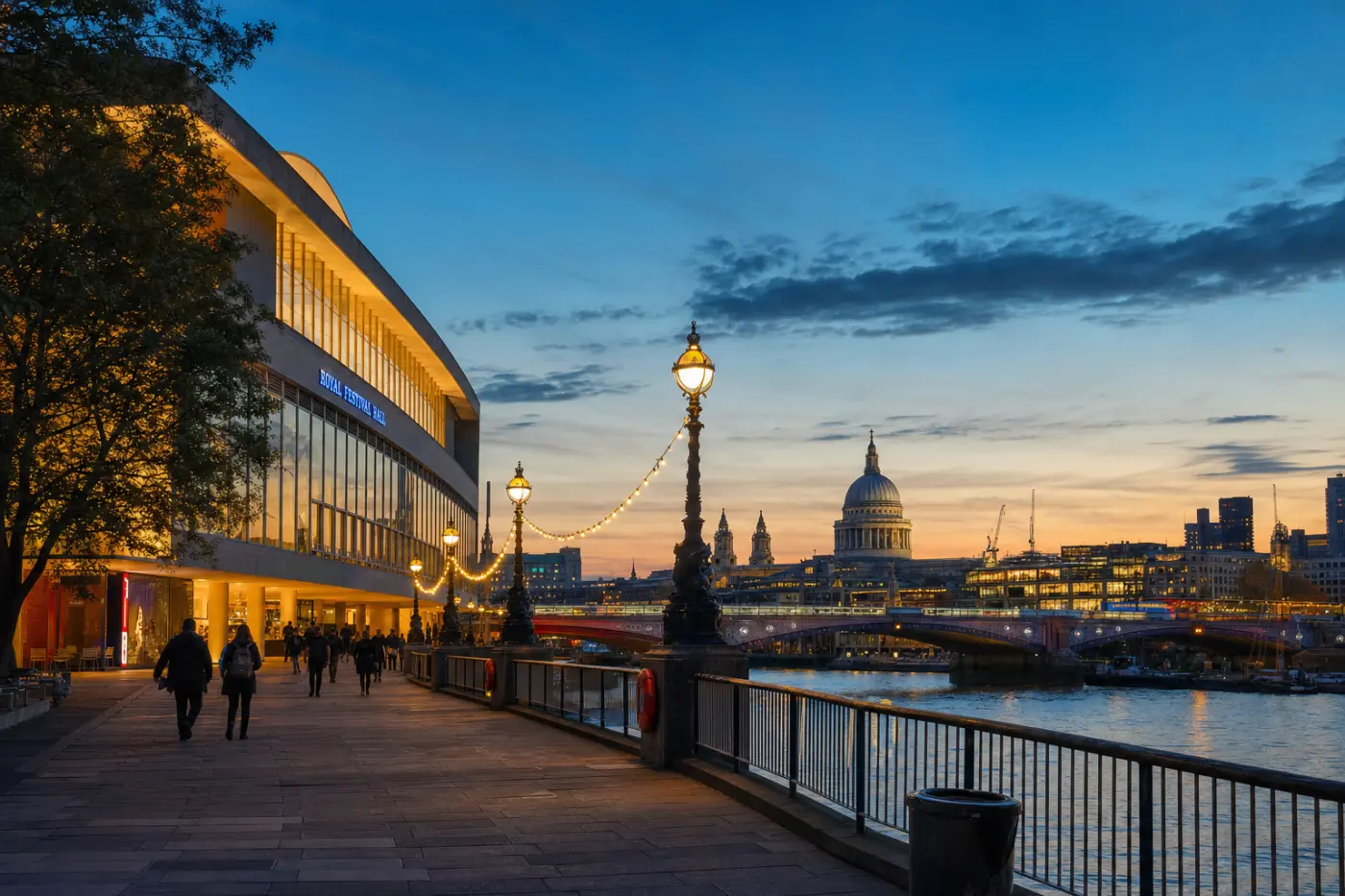
Tourist attraction
The South Bank occupies the southern bank of the River Thames in the London Borough of Lambeth, running roughly one mile between Westminster Bridge to the southwest and Blackfriars Bridge to the east. For much of its history the area was industrial and marshy — a working waterfront of warehouses, factories, and wharves that stood in sharp contrast to the civic grandeur of the north bank. That identity was permanently altered by the Festival of Britain in 1951, a government-led initiative to lift post-war morale and showcase British design and innovation. The festival's centrepiece, the Royal Festival Hall, was the only permanent structure built for the event and remains the anchor of the South Bank to this day, seating over 3,000 audience members and serving as the home of the London Philharmonic Orchestra.
The decades that followed the Festival of Britain saw a deliberate accumulation of cultural institutions along the riverfront. The Queen Elizabeth Hall and the smaller Purcell Room opened in 1967, expanding the Southbank Centre's concert offering. The Hayward Gallery followed in 1968, bringing major visual art exhibitions to the brutalist complex. The National Theatre, designed by Sir Denys Lasdun in raw concrete and opened in stages between 1976 and 1977, added a third major institution to the quarter and cemented the South Bank's reputation as London's foremost address for the performing arts. A short walk east toward Bankside, the reconstructed Shakespeare's Globe — opened in 1997 on a site 230 metres from the original 1599 theatre — extends the cultural corridor into the Elizabethan past. The BFI Southbank, the British Film Institute's principal cinema, completes the roster of major venues and has screened films continuously on this site since 1952.
Walking the South Bank today means moving through a near-continuous programme of free and ticketed events. Street performers occupy the areas beneath Waterloo Bridge, independent booksellers run a long-established secondhand market under the bridge's eastern arch, and the riverside promenade connects Tate Modern (housed in the former Bankside Power Station, which closed in 1981 and reopened as a gallery in 2000) to the London Eye, the 135-metre observation wheel erected for the millennium in 1999. The views across the Thames take in St Paul's Cathedral, Somerset House, and the Palace of Westminster, making the walk one of the most photographed urban routes in Europe.
The South Bank is fully accessible on foot from Waterloo station (National Rail and the Bakerloo, Jubilee, and Northern lines), which is a five-minute walk from the Royal Festival Hall. Southwark station on the Jubilee line places visitors directly beside Tate Modern and the Globe. The promenade is open at all hours, free to walk, and at its most atmospheric at dusk when the bridges and north-bank skyline reflect across the river. For venue performances, booking in advance is strongly recommended, particularly for the National Theatre and Royal Festival Hall, both of which frequently sell out weekend programmes weeks ahead.
Private tours with a local guide, at your own pace.
London
London
London
London
London
London
London
London