3 hrs
London
London: Private Family Tour, Natural History Museum & Games
✓ Free cancellation Kids friendly
4.5(0 reviews)
From €208/ person
Book Now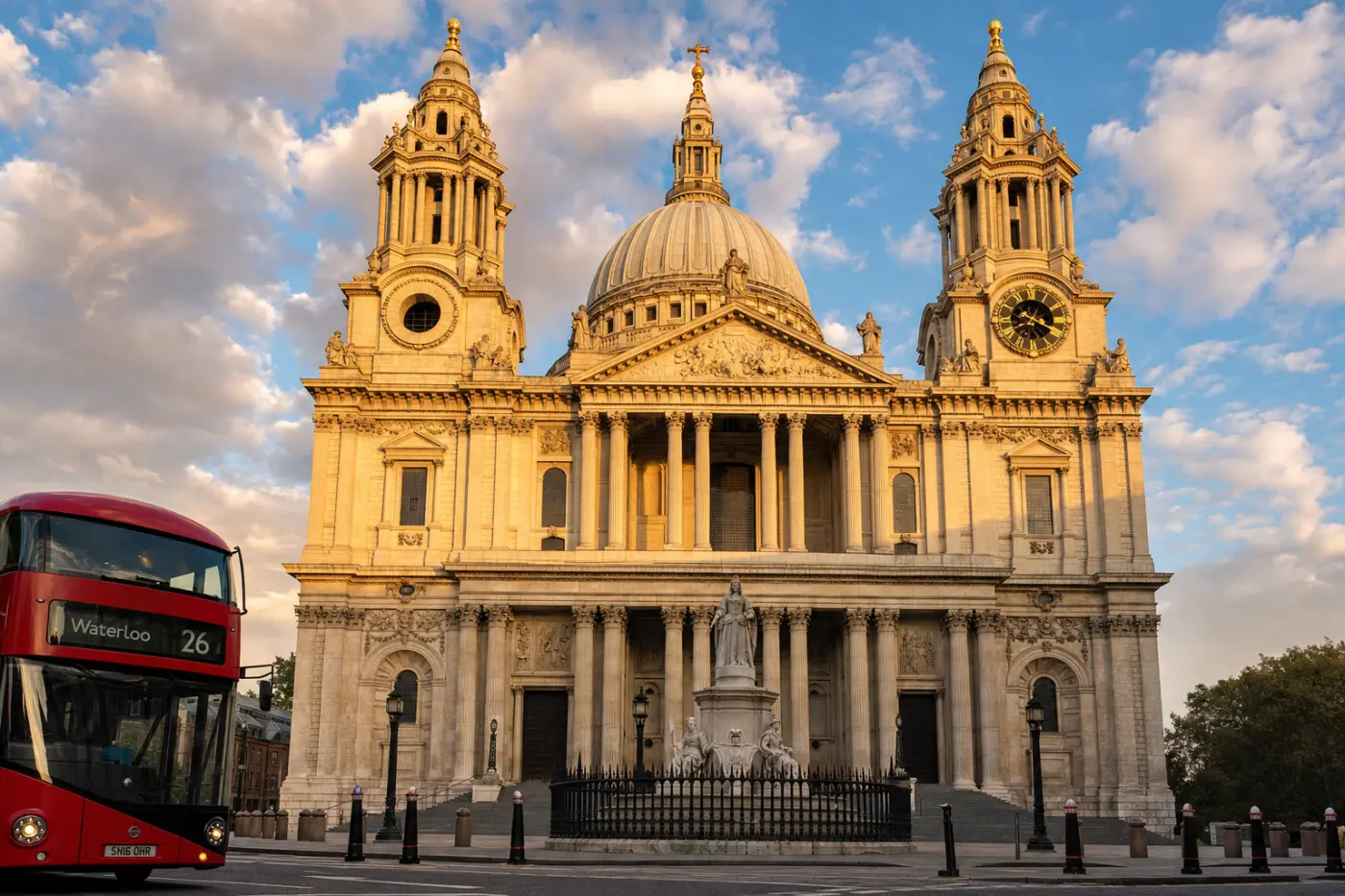
Tourist attraction
St. Paul's Cathedral stands on Ludgate Hill — the highest point in the City of London — and represents the fourth church to occupy this sacred ground. The first was a modest timber structure erected in 604 AD by St. Mellitus, the first Bishop of London, under the orders of King Aethelbert of Kent. A stone successor followed in 675 AD, and in 1087 William the Conqueror commissioned a far grander Norman cathedral that served the Diocese of London for nearly 600 years. That building was consumed by the Great Fire of London in September 1666, clearing the way for Sir Christopher Wren's defining commission. Construction on the current cathedral began in 1675 and was completed in 1710, making it the first cathedral in England to be built and finished under a single architect's supervision.
Wren's design draws explicit inspiration from St. Peter's Basilica in Vatican City and the Roman Pantheon, most visibly in its commanding dome. Rising 365 feet (111 metres) to the top of the cross, the dome is the second largest in the world and remained the tallest structure in London from its completion until 1962. The interior reveals three distinct gallery tiers within the dome: the Whispering Gallery at 30 metres above the cathedral floor, where the curved masonry carries a whisper audibly across 34 metres to the opposite wall; the Stone Gallery on the outer drum; and the Golden Gallery at the very summit, reached via 528 steps and rewarding visitors with a panoramic sweep across the capital. Wren's structural solution for the dome was also innovative — a hidden brick cone supports the outer lead-covered timber shell and the interior painted ceiling simultaneously, a feat of engineering not fully understood by the public for generations.
The cathedral has witnessed some of the most consequential moments in British history. The state funerals of Admiral Lord Nelson (1806), the Duke of Wellington (1852), Sir Winston Churchill (1965), and Baroness Thatcher (2013) were all held here. The wedding of Prince Charles and Lady Diana Spencer took place beneath the dome on 29 July 1981, watched by a global television audience of 750 million. In 1964, Martin Luther King Jr. preached a sermon here at the invitation of Canon John Collins, addressing a congregation of over 3,000 at a pivotal moment in the civil rights movement. The cathedral survived the Blitz of World War II despite surrounding streets being devastated — the image of its dome emerging from the smoke of burning London became one of the defining photographs of the war.
Visitors should plan a minimum of two hours to do justice to the cathedral. Beyond climbing the dome galleries, the interior rewards close attention: Jean Tijou's ornate wrought-iron choir screen gates (c. 1698), the mosaics in the quire apse, and Grinling Gibbons's carved choir stalls are all exceptional examples of late 17th-century craftsmanship. The crypt, one of the largest in Europe, contains the tombs of both Nelson and Wellington, as well as Wren's own grave — marked by his son's famous Latin inscription, "Lector, si monumentum requiris, circumspice" (Reader, if you seek his monument, look around you). Advance ticket booking is strongly recommended; the cathedral is an active place of worship and certain areas may be restricted during services.
Private tours with a local guide, at your own pace.
London
London

London
London
London
London
London
London