3 hrs
London
London: Private Family Tour, Natural History Museum & Games
✓ Free cancellation Kids friendly
4.5(0 reviews)
From €208/ person
Book Now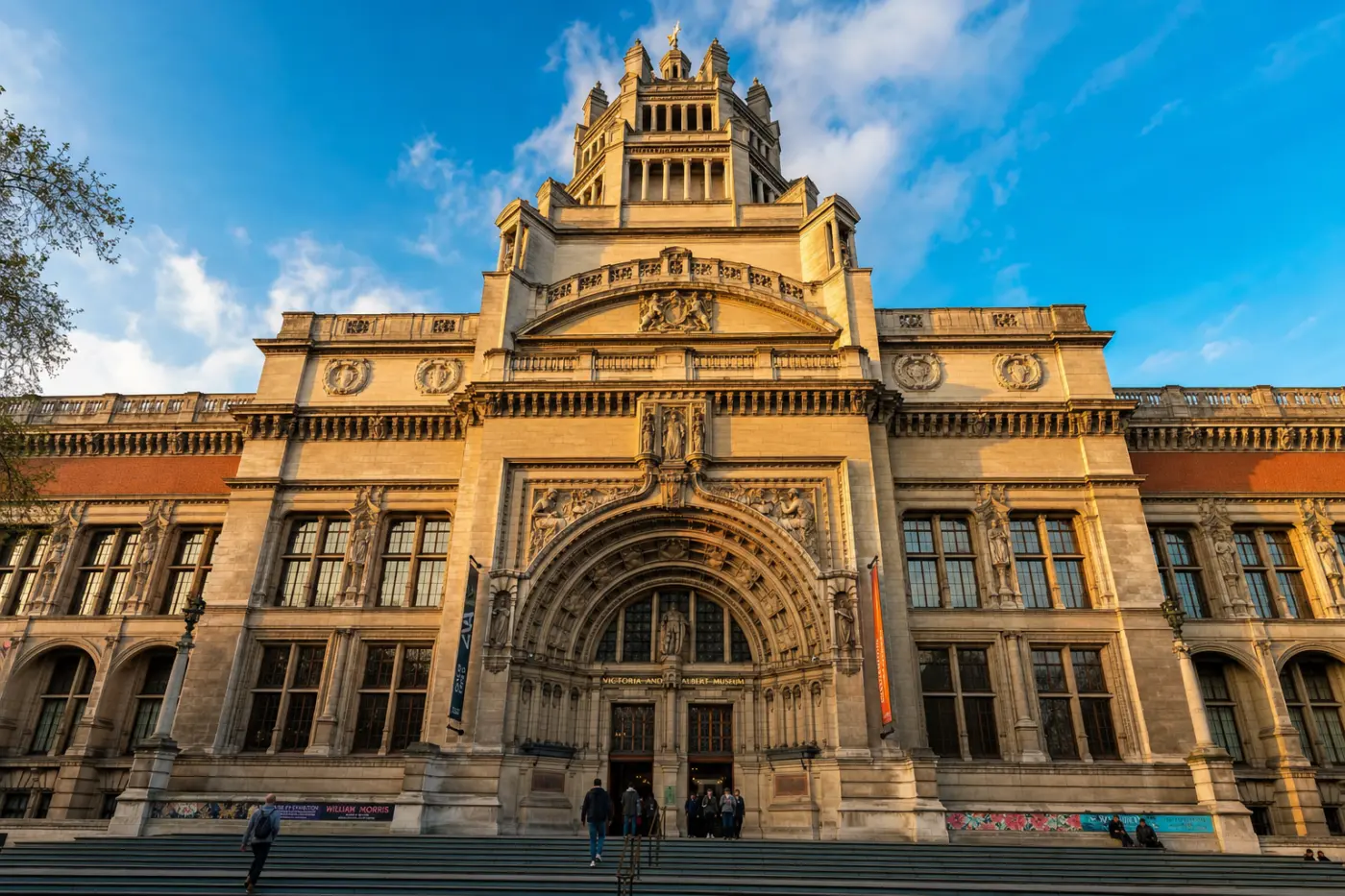
Tourist attraction
The Victoria and Albert Museum — universally known as the V&A — is the world's largest museum of applied arts, decorative arts, and design, holding a permanent collection of over 2.27 million objects that spans 5,000 years of human civilisation. Founded in 1852 under the name Museum of Manufactures at Marlborough House in Pall Mall, it relocated to its current South Kensington site in 1857 as the South Kensington Museum. Queen Victoria laid the foundation stone of the present buildings on Exhibition Road and Cromwell Road in 1899, at which point the museum was formally renamed in honour of herself and her late consort, Prince Albert — though Victoria had originally lobbied simply for "the Albert Museum." The surrounding neighbourhood, now known as South Kensington, was itself rebranded from the less glamorous "Brompton" by museum authorities seeking a more fashionable address. The entire district — including the nearby Natural History Museum, Science Museum, Royal Albert Hall, and Imperial College — sits on land purchased partly from profits of the Great Exhibition of 1851, earning it the affectionate nickname "Albertopolis."
The institution has a remarkable history of firsts. The South Kensington Museum was the first museum in the world to open a public restaurant, a tiered affair with separate first- and second-class menus and a "third class service" for workmen employed on the building. It was also the first museum globally to introduce gas lighting in its galleries, enabling evening openings — a deliberate social policy by founding Director Sir Henry Cole, who hoped that late-night museum access might serve as "a powerful antidote to the gin palace." The Science Museum, now a separate institution next door, was originally a department of the V&A until it split off in 1909. The South and South-East Asian collections trace their origins to the East India Company's India Museum, founded in 1801 and transferred to South Kensington in 1879.
Spread across 145 galleries, the V&A's collection defies easy summary. Highlights include the Ardabil Carpet (1539–40), one of the world's oldest and most celebrated Islamic carpets; the Cast Courts, a pair of vast Victorian halls housing full-scale plaster reproductions of Trajan's Column and Michelangelo's David; an unrivalled collection of Raphael Cartoons on loan from the Royal Collection since 1865; and the largest collection of post-Classical sculpture outside Italy. Fashion, jewellery, ceramics, glass, ironwork, photography, theatre design, and digital art all have dedicated gallery spaces. The building itself, designed by Sir Aston Webb and completed in 1909, is a landmark of Edwardian Baroque, with a terracotta facade and the iconic domed lantern that crowns the main entrance on Cromwell Road.
Admission to the permanent collection is free, and the museum is open daily from 10:00 to 17:45, with Friday late-night opening until 22:00 — a tradition that echoes Cole's original Victorian vision. Temporary exhibitions carry a ticket charge and should be booked in advance. The museum's café occupies the original Victorian Refreshment Rooms, including the stunning Gamble Room with its Minton-tiled walls and enamelled ironwork — themselves now listed as historic exhibits. South Kensington Underground station (Piccadilly, Circle, and District lines) is a five-minute walk via the dedicated Exhibition Road tunnel.
Private tours with a local guide, at your own pace.
London
London
London
London
London
London
London
London