3 hrs
London
London: Private Family Tour, Natural History Museum & Games
✓ Free cancellation Kids friendly
4.5(0 reviews)
From €208/ person
Book Now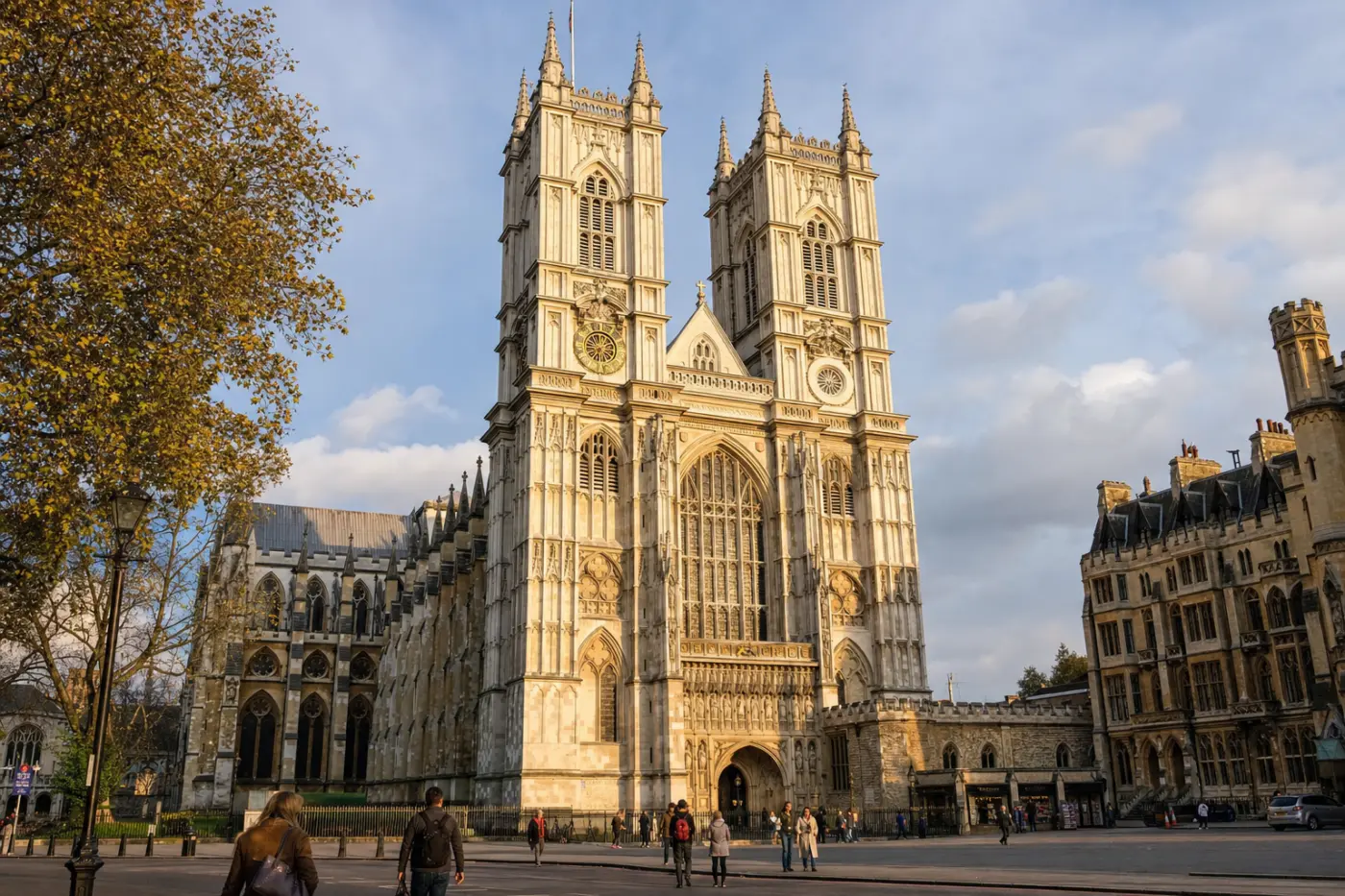
Tourist attraction
Formally known as the Collegiate Church of Saint Peter at Westminster, Westminster Abbey began as a small Benedictine monastery founded around 960 AD under the patronage of King Edgar and St Dunstan. It was King Edward the Confessor who transformed it into a landmark of national significance, rebuilding it as a grand stone church in honour of St Peter the Apostle in the 1040s. The new church was consecrated on 28 December 1065 — Edward was too ill to attend and died days later, his remains entombed before the High Altar. Within a year, on Christmas Day 1066, William the Conqueror was crowned here, establishing a tradition of royal coronation that has continued unbroken for nearly a millennium. Every English and British monarch since — 39 coronations in total — has been crowned within these walls, with the sole exceptions of Edward V and the abdicated Edward VIII. The most recent was Queen Elizabeth II on 2 June 1953, the first coronation ever televised.
The soaring Gothic structure visitors see today owes its form to King Henry III, who ordered a complete rebuild beginning in 1245, inspired by the great French cathedrals of Amiens, Evreux, and Chartres. Henry consecrated the new church on 13 October 1269, though the nave remained incomplete at his death and was not finished until the 16th century. The west towers, often mistaken for medieval work, were added between 1722 and 1745 to designs by Nicholas Hawksmoor. The Abbey is also a UNESCO World Heritage Site and attracts over one million visitors annually. Beyond coronations, it has hosted 17 royal weddings, most recently the marriage of Prince William and Catherine Middleton on 29 April 2011, and served as the setting for state funerals of figures including Sir Winston Churchill and Diana, Princess of Wales.
The Abbey is the final resting place of more than 3,300 people across 1,000 years of British history. Poets' Corner, in the south transept, holds the tombs and memorials of Geoffrey Chaucer, Charles Dickens, Thomas Hardy, Rudyard Kipling, and Alfred Lord Tennyson, among many others. The Grave of the Unknown Warrior, installed on 11 November 1920, contains the body of an unidentified British soldier from the Western Front and remains one of the most visited graves in the world. The medieval Shrine of St Edward the Confessor — moved to a new tomb after Edward's canonisation in 1161 — sits at the Abbey's physical and spiritual heart, surrounded by the tombs of five medieval kings and four queens. The oldest surviving features of Edward's original 11th-century monastery, the Pyx Chamber and the undercroft, can still be seen in the cloisters.
Visitors enter through the Great North Door and can explore the nave, choir, chapels, and cloisters on a self-guided audio tour or with a guided group. The College Garden, one of the oldest gardens in England with over 900 years of continuous cultivation, offers a rare moment of quiet within the bustle of central London. The Abbey remains an active place of daily worship — not a cathedral or a parish church, but a "Royal Peculiar" answering directly to the Sovereign — so services occasionally limit tourist access to certain areas. Book timed entry tickets well in advance, particularly in summer; the Abbey is closed to visitors on Sundays, when it is open for worship only. Photography is not permitted inside.
Private tours with a local guide, at your own pace.
London
London

London
London
London
London
London
London